
The Ultimate Stuttgart Showdown: Porsche 992 GTS vs 997 GTS and the Evolution of the 911
If you have spent any significant amount of time in the automotive industry over the last decade, you already know that the Porsche 911 is not just a car; it is a continuously evolving organism. As a seasoned automotive journalist and test driver with over ten years of experience evaluating Stuttgart’s finest on everything from Southern California canyon roads to the sweeping tarmac of the track, I have witnessed this evolution firsthand. Today, we stand at a fascinating crossroads in 2025. The hybrid era has officially arrived for the quintessential sports car, bringing us to a highly anticipated comparison: the Porsche 992 GTS vs 997 GTS.
This isn’t just a standard side-by-side spec check. It is a deep, analytical look into how a modern, electrified powerhouse stacks up against the analog hero that originally revived the GTS moniker. The Porsche 992 GTS vs 997 GTS debate perfectly encapsulates the broader transition of the U.S. luxury auto market—from tactile, mechanical simplicity to software-driven, hybrid dominance.
The Genesis: Why the 997 GTS Remains an Icon
To truly understand the magnitude of the Porsche 992 GTS vs 997 GTS matchup, we have to rewind to the late 2000s. The champagne corks must have been flying in Stuttgart when the product planners conceptualized the original 997-generation Carrera GTS. The mission was straightforward: engineer a graceful exit for the 997 series—the universally praised second chapter of the water-cooled 911s—before the longer, electric-steering-equipped 991 generation took over.
Porsche needed something that would keep showroom foot traffic heavy without incurring massive research and development costs. They dusted off the GTS (Gran Turismo Sport) badge—a nameplate famously tied to the legendary 904 GTS racer of the 1960s and the muscular 928 GTS of the 1990s. The engineers essentially walked into the Porsche parts department, flipped open the bins, and created magic.
They wisely left the hardcore GT3 components on the shelf. Instead, the 997 GTS became the very first non-motorsport 911 to marry the coveted wide-body chassis with rear-wheel drive. Under the rear hood sat a naturally aspirated 3.8-liter flat-six engine. While it shared DNA with the ultra-exclusive Sport Classic, it was essentially a standard Carrera S engine fitted with the highly desirable Powerkit, pushing output to a healthy 408 horsepower.
Porsche threw in PASM adaptive dampers and a throatier sports exhaust as standard equipment. If you wanted the truly aggressive setup, things like the limited-slip differential, carbon-ceramic brakes, and sport suspension were left on the options list. Visually, the car was treated to a unique front splitter, center-lock alloy wheels, a Sport Design steering wheel swathed in Alcantara, and a scattering of subtle GTS badges. Back then, the price premium to jump from a Carrera S to a GTS was incredibly modest. Today, pristine examples of the 997 GTS are prime targets for luxury sports car investments, highly sought after by purists who recognize it as the pinnacle of analog 911 engineering.
The Modern Behemoth: Unpacking the 992 Carrera GTS T-Hybrid
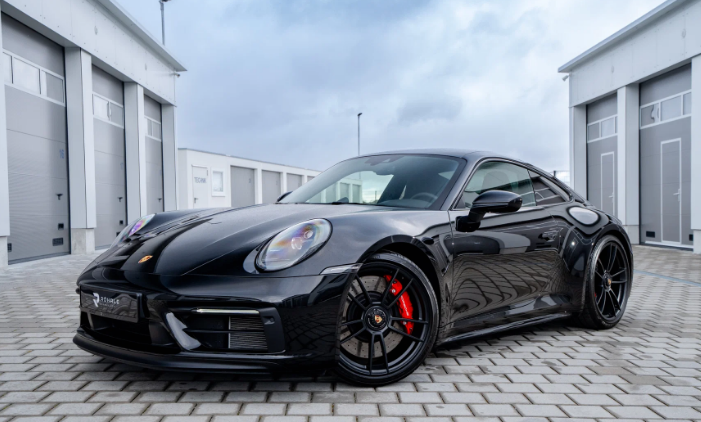
Fast forward to 2025, and the landscape of the Porsche 911 Carrera GTS has shifted dramatically. When comparing the Porsche 992 GTS vs 997 GTS, the technological gulf is staggering. The new 992 Carrera GTS T-Hybrid is no longer a modest parts-bin special; it is a bleeding-edge technological marvel that sets the tone for the entire Porsche lineup.
In previous generations, the GTS was the final model released before a chassis update. Today, the 992.2 GTS is the spearhead, proving just how critical this sub-brand has become to Porsche’s bottom line. While the current base Carrera retains the traditional 3.0-liter twin-turbo setup, the new GTS boasts an entirely bespoke 3.6-liter flat-six engine mated to an innovative T-Hybrid system. The result? A monstrous 533 horsepower and 450 lb-ft of torque.
This hybrid architecture isn’t about hypermiling on your commute; it is entirely focused on performance. The electric motor acts as an instantaneous torque-fill mechanism, eliminating turbo lag entirely. In the traction-limited environment of rear-wheel drive, the new GTS rockets from 0 to 60 mph faster than almost anything in its class. In fact, over the first few dozen yards off the line, the instant response of the hybrid system makes it feel quicker than even the mighty 911 Turbo S.
However, this staggering performance comes at a cost. The price walk from a Carrera S to the new 992 GTS is now a massive leap, though it does include high-dollar hardware like rear-wheel steering as standard. If you are looking into exotic car financing to put one of these in your garage, prepare for a sticker price that rivals the supercars of just a few years ago. Furthermore, the integration of the hybrid system means the manual transmission is officially dead for the GTS. The PDK automatic is your only option. For the hardcore enthusiast, that is a bitter pill to swallow.
Behind the Wheel: Analog Soul vs. Digital Dominance
Paper statistics only tell half the story. The real crux of the Porsche 992 GTS vs 997 GTS debate is how these machines communicate with the driver on a twisting strip of asphalt.
Let us start with the new arrival. Everyone who climbs into the driver’s seat of the 992 GTS T-Hybrid walks away repeating the exact same sentiment: it is violently, unbelievably fast. During my testing period with the car, I found myself recalibrating my brain to keep up with the sheer pace. You simply turn the steering wheel dial to “Sport,” and the throttle response sharpens to a razor’s edge. The torque is omnipresent. You don’t need to hunt for the right gear to make a pass; you simply flex your right foot, and the horizon fast-forwards.
Yet, for all its blistering speed, the 992 is remarkably civilized. It features a fully digital dashboard, cutting-edge infotainment, and enough acoustic insulation to make it a supreme grand tourer. But when you switch to manual mode and take control of the PDK paddles, you discover a brutal, relentless machine. It is so fast that on public roads, you can only deploy its full potential in micro-bursts of a few seconds before risking your license.
Now, step out of the 992 and slide into the cabin of the 15-year-old 997 GTS. The contrast is jarring, yet profoundly refreshing. You insert a physical key into the ignition on the left side of the steering column and twist. The 3.8-liter engine barks to life with a mechanical, oily resonance that the modern hybrid simply cannot replicate.
The 997 feels distinctly vintage from the driver’s seat. The five physical dials stare back at you, the Alcantara steering wheel is completely free of buttons or screens, and the center console features old-school climate toggles. But the true revelation happens the moment you engage the heavy clutch and slot the six-speed manual shifter into first gear. The tactile, mechanical action of that gearbox is a masterpiece—a level of engagement denied to modern buyers unless they step up to a GT3.
Out on sweeping mountain roads, the original 911 Carrera GTS reveals its true magic. Below 6,000 rpm, it doesn’t feel substantially faster than a standard Carrera S of its era. But keep your foot planted, wait for the intake flaps to open at the top end of the rev range, and the engine takes a deep breath, screaming gloriously all the way to 7,300 rpm.
The Weight of Progress: Physics and Engagement
When evaluating the Porsche 992 GTS vs 997 GTS, the most critical physical difference is weight. The 997 GTS is roughly 400 pounds lighter than the modern 992 T-Hybrid.
This weight difference defines the handling characteristics of both cars. The 992 is a physically massive vehicle. It requires enormous brakes, wide tires, complex active suspension systems, and rear-wheel steering just to manage the mass of its larger chassis, electric motors, and battery packs. It grips the road with a violent tenacity, but it feels heavily managed by silicon and software.
The 997 GTS, aided by a wheelbase that is nearly four inches shorter and traditional hydraulic power steering, feels entirely organic. It is a lithe, agile dance partner. The hydraulic steering chatters constantly, sending a high-fidelity stream of information through the wheel rim straight to your palms. You know exactly what the front tires are doing at all times.
While the 992 GTS feels hemmed in by the constraints of public roads—forcing you to drive at a fraction of its capability—the 997 allows you to use all of its performance. You can wring out the gears, lean into the suspension, and ride the edge of mechanical grip without feeling like you are defying the laws of physics. It is an immersive, joyous experience that reminds you why people fall in love with driving.
Investment Value and the Market Landscape
From a financial perspective, the Porsche 992 GTS vs 997 GTS comparison is a study in modern car economics. The 992 GTS is an expensive, depreciating asset, albeit one that offers world-beating performance. If you are stepping into the U.S. luxury auto market for a brand-new hybrid 911, you will need to navigate high-end auto insurance policies and potentially complex exotic car financing setups, as well-optioned models easily push toward the $200,000 mark.
Conversely, the 997 GTS has firmly entered the realm of luxury sports car investments. Because it represents the absolute zenith of the water-cooled, naturally aspirated, hydraulically steered, manual-transmission Carrera bloodline, values are rock solid. Collectors and driving enthusiasts alike are hunting for clean, low-mileage, three-pedal 997 GTS coupes. Buying one today is not just acquiring a phenomenal driving tool; it is placing your money into a blue-chip automotive asset. High-level Porsche 911 performance tuning is also highly popular for this generation, though purists prefer them bone stock to retain maximum resale value.
A Lesson from the 911 S/T: The Limits of Modern Grip
To fully contextualize where the modern 911 is heading, it is worth looking tangentially at the highly exclusive Porsche 911 S/T. Driving the S/T recently highlighted a growing issue with modern ultra-performance Porsches. The S/T is marketed as the ultimate road-focused 911, a car so pure that Porsche actively refused to set a Nürburgring lap time with it.
Yet, they deliver the car on Michelin Cup 2 track tires. On a damp canyon road, this tire choice makes the car nervous and spiky. Instead of progressive, easily manageable slides that you can balance on the throttle—a hallmark of classic 911s like the 997—the modern track rubber results in sudden snaps of oversteer. It begs the question: why put a track-day tire on a car expressly designed for public roads?
This highlights the genius of the older 997 GTS. It doesn’t rely on hyper-aggressive tire compounds or computerized torque vectoring to stay on the road. It relies on brilliant, fundamental chassis geometry. It is approachable. It doesn’t scare you when the weather turns; it communicates with you.
The Final Verdict
The Porsche 992 GTS vs 997 GTS debate ultimately comes down to what you seek from a sports car.
The 992 Carrera GTS T-Hybrid is a technological tour de force. It represents the successful integration of hybrid technology into the world’s most famous sports car without sacrificing a single ounce of raw pace. It is a continent-crushing missile that will outrun supercars from a stoplight and coddle you in digital luxury on the way home. It is undeniably the better, faster, and more capable machine.
But the 997 GTS is the better sports car. It possesses an analog soul that software simply cannot emulate. The snick-snack of the manual gearbox, the vocal howl of the 3.8-liter engine, and the telepathic feedback of the hydraulic steering create an emotional resonance that stays with you long after you have parked the car and walked away.
In the modern era of electrification, the 992 GTS shows us an incredibly bright, impossibly fast future. But the 997 GTS reminds us of a perfect past—and proves exactly why it will forever remain an icon.
Are you ready to experience the thrill of Stuttgart’s finest engineering for yourself? Whether you are looking to secure exotic car financing for a modern hybrid or searching for a pristine classic to add to your luxury sports car investment portfolio, the perfect 911 is out there waiting for you. Drop a comment below with which generation you would choose, and subscribe to our newsletter for exclusive weekly insights into the high-end automotive market.