
Evaluating the 2026 Toyota Land Cruiser Commercial: The Ultimate Off-Road Cargo Van Built for Tax Efficiency
When navigating the most unforgiving environments on Earth, few badges carry the sheer survival currency of a Toyota Land Cruiser. From the sun-baked expanses of the Sahara Desert to the treacherous corrugations of the Australian Outback, this nameplate is synonymous with indestructible reliability. I was recently reminded of this market dominance during a desert excursion in Morocco. While testing high-performance EVs, I watched countless generations of trail-hardened Land Cruisers effortlessly tackle remote terrain that would instantly break lesser 4x4s. However, there is a fascinating new anomaly within this legendary bloodline currently disrupting the European commercial market.
Enter the 2026 Toyota Land Cruiser Commercial, a heavy-duty, two-seat cargo rig that strips away passenger capacity to prioritize pure utility and, perhaps most importantly, massive financial loopholes. Built upon the highly acclaimed “J250” architecture, this vehicle represents a growing niche of SUV cargo conversion models tailored specifically for fleet operators and rural businesses.
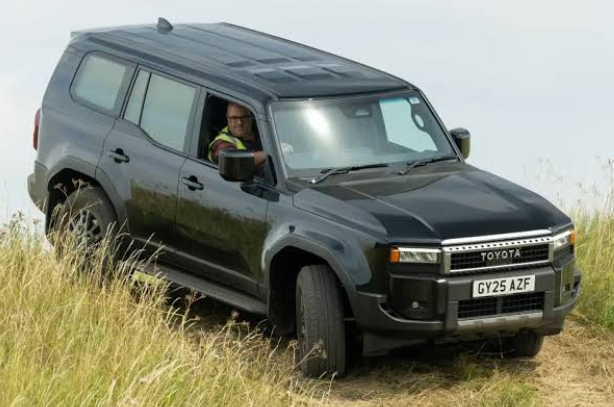
Interestingly, this utilitarian transformation does not occur on the primary assembly lines in Japan. These vehicles arrive in Britain as standard, fully equipped passenger SUVs. They are then meticulously stripped and retrofitted at Toyota’s manufacturing facility in Derbyshire—the exact same plant responsible for preparing U.S.-bound GR Corollas. By deleting the second and third seating rows in favor of a vast, flat load floor, Toyota has engineered one of the most capable fleet off-road vehicles available on the global market today.
The Financial Strategy: Commercial Vehicle Tax Benefits Explained
The driving force behind this specialized cargo rig is not solely a desire for a rugged delivery vehicle; it is an ingenious play for commercial vehicle tax benefits. In regions like the U.K. and the Republic of Ireland, the taxation system heavily penalizes high-emission passenger vehicles while offering lucrative incentives for commercial utility vehicles (Light Commercial Vehicles, or LCVs).
When registered as a commercial vehicle, operators benefit from significantly lower purchase taxes and vastly reduced ongoing duty for business-use vehicles. To put the math into perspective, a standard passenger-carrying Land Cruiser in the U.K. incurs a staggering Vehicle Excise Duty (VED) of £5,490 (roughly $7,340). By opting for the 2026 Toyota Land Cruiser Commercial, that annual tax liability plummets to just £345 (around $460).
This colossal financial advantage explains the recent surge in commercial SUV financing applications across Europe. It also highlights why direct competitors, including the Land Rover Defender Hard Top and the Ineos Grenadier Commercial, are aggressively pushing their own stripped-down variants to capture this lucrative, tax-skirting market segment.
Inside the Cabin: Utilitarian Sacrifice Meets Executive Luxury
Getting behind the wheel reveals a fascinating juxtaposition between high-end automotive luxury and strict commercial compliance. Toyota’s engineers went to great lengths to ensure this vehicle legally qualifies as a commercial rig without compromising the exterior aesthetics.
Fixed Glass and Protection: The rear doors retain their exterior glass to preserve the SUV’s profile, but the windows are completely fixed. Heavy-duty interior blanking panels are installed directly behind the glass to protect it from shifting heavy cargo.
Disabled Controls: The window motors remain housed within the rear door panels, but the switches have been blanked out with factory-grade plastic plates. The rear window controls on the driver’s door are similarly permanently deactivated.
Irreversible Cargo Bay: In the rear, all passenger grab handles and seatbelts have been surgically removed. To prevent clever owners from attempting an illegal DIY passenger conversion to bypass tax laws, the original seat mounting points have been physically cut out of the chassis and sealed beneath a durable, flat load floor.
Safety Integration: A sturdy, full-height mesh bulkhead separates the front cabin from the cargo bay, keeping the driver and single passenger safe from shifting equipment.
Oddly enough, the third-row cupholders remain integrated into the rear plastic moldings—a quirky, vestigial reminder of its passenger-hauling origins. Despite these utilitarian downgrades, it remains remarkably luxurious. Operators still benefit from heated and ventilated power-adjustable front seats, radar-guided adaptive cruise control, and a premium audio system. It even keeps the power-operated tailgate with its independently opening upper glass hatch, though the utility of a high-riding split tailgate is somewhat compromised when loading heavy pallets.
Powertrain Engineering: The 2.8-Liter Turbodiesel Engine
For automotive purists and fleet managers alike, one of the most compelling reasons to evaluate this vehicle is the powertrain architecture. Powering this off-road cargo van is a highly evolved 2.8-liter turbodiesel engine—a forbidden-fruit powertrain no longer offered in the U.S. market but universally revered by global overland enthusiasts.
Enhanced by a new 48-volt mild-hybrid (MHEV) system, this robust four-cylinder diesel block generates 202 horsepower and a substantial 369 lb-ft of torque. On paper, those output figures might seem modest when tasked with moving a 5,200-pound unladen curb weight. However, the engineering magic lies in the torque delivery. With peak twist available from an ultra-low 1,600 rpm, the 48-volt system provides essential torque-fill off the line, partnering brilliantly with an intelligently calibrated eight-speed automatic transmission.
It is worth noting that this 2.8-liter turbodiesel engine prioritizes mechanical durability over acoustic refinement. It lacks the silky smoothness found in the inline-six diesels of its European rivals. Operators can expect noticeable vibration at idle and a vocal, gravelly soundtrack under heavy acceleration. The transmission programming is heavily biased toward low-end grunt, aggressively upshifting before 3,800 rpm even with the throttle pinned to the floor mat. If you want to see the digital tachometer hit its 4,400-rpm redline, you must lock the transmission into manual mode and force the issue.
Driving Dynamics: Highway Composure and Trail Dominance
Cruising down the highway, the vehicle settles into a steady, confident rhythm. Once at speed, the noise, vibration, and harshness (NVH) levels are highly acceptable, easily cementing its status as the best 4×4 commercial van for long-haul driver comfort when compared to a standard, echo-chamber panel van like a Ford Transit.
Toyota quotes a 0-62 mph sprint of 10.2 seconds, a metric that feels largely irrelevant for a vehicle designed to haul heavy machinery across muddy agricultural sites. Under hard acceleration, the suspension tuning reveals its commercial bias, squatting noticeably over the rear axle with a distinct nose-up attitude. This is not a precision track instrument; at highway speeds exceeding 75 mph, the Dunlop AT23 Grandtrek tires can induce a slight wander within the lane, and the windshield wipers begin to struggle against the aerodynamic drag.
Unladen, the suspension feels distinctly underdamped over broken pavement, translating sharp jolts into the cabin. However, commercial vehicles are engineered to work, and adding payload entirely transforms the chassis dynamics. During testing, strapping a 220-pound piece of vintage industrial equipment into the cargo bay completely settled the ride. Bumps and undulations were absorbed with the premium composure you expect from the TNGA-F ladder-frame platform.
When the tarmac ends, the 2026 Toyota Land Cruiser Commercial retains 100% of its legendary off-road DNA. It features a dual-range transfer case, a manually locking center differential, and an advanced traction-management system capable of clawing through deep, sun-baked ruts and slick mud with absolute indifference.
Payload and Towing: Assessing Commercial Practicality
Evaluating its viability as a pure cargo hauler reveals a few structural compromises inherent to SUV cargo conversions. The cargo bay measures 66.4 inches in length, 50.6 inches in width, and 42.9 inches in height. While spacious, the high load floor—a mechanical necessity to clear the heavy-duty four-wheel-drive components and live rear axle—makes lifting awkwardly shaped items significantly more strenuous than loading a traditional low-floor delivery van. Furthermore, the long, top-hinged power tailgate requires considerable rearward clearance to open fully, which can be frustrating in tight urban loading zones compared to traditional dual barn doors.
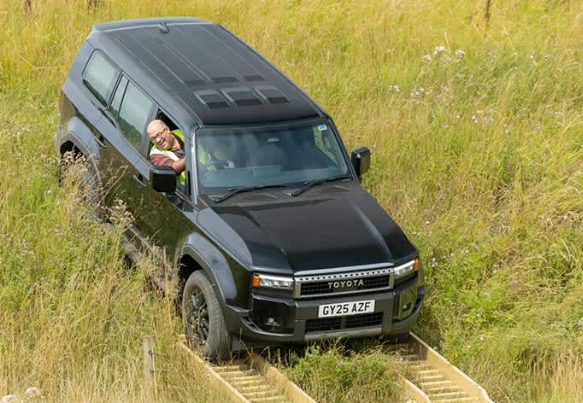
Yet, where it lacks in ergonomic loading, it overcompensates with raw capacity. The vehicle boasts a maximum payload capacity of 1,780 pounds in the rear bed. Furthermore, the impressive Toyota Land Cruiser towing capacity remains fully intact, officially rated to pull up to 7,700 pounds (3,500 kg)—the absolute maximum legal limit for a vehicle of this classification under European transport regulations. For fleet managers requiring a vehicle that can drag heavy equipment trailers into remote forestry, mining, or utility sites, these working figures are unmatched.
Ultimately, the 2026 Toyota Land Cruiser Commercial forces specific compromises upon its operator—namely, the strict inability to transport more than one passenger and a cargo space that requires heavy lifting to utilize. Yet, it counters these drawbacks with indestructible build quality, formidable all-terrain capability, and undeniable financial logic. Priced at £50,640 (approximately $67,800) before taxes, it undercuts the most affordable passenger-spec Land Cruiser by nearly £9,000 ($12,000). For business owners looking to maximize their fleet efficiency while driving one of the most reliable vehicles ever engineered, this tax-skirting cargo rig is a brilliant strategic investment. What terrain is your current fleet struggling to conquer, and how much could a conversion like this save your business this fiscal year?