
2026 BMW M240i xDrive vs. Audi RS3: Is the £50k Sports Coupe a Better Value Than the Ultimate Hot Hatch?
Navigating the high-performance car market in 2026 requires a recalibration of value. Not too long ago, a £50,000 budget granted access to lightweight sports cars, high-output hot hatches, and even entry-level super saloons. Today, inflationary shifts, electrifying powertrain mandates, and strict emissions compliance have reshaped pricing structures across the automotive industry. The affordable petrol hot hatch is rapidly fading into history, pushing enthusiasts toward a smaller, more expensive pool of vehicles.
Yet, two distinct philosophies continue to battle for modern performance dominance: the traditional rear-biased sports coupe and the mega-hatch. At £50,000, the updated BMW M240i xDrive stands as one of the few remaining bargains in the entry-level luxury sports car sector. Facing off against it is the Audi RS3—a vehicle priced around £62,000 that pushes the boundaries of hyper-hatch engineering.
Does BMW’s entry-level sports coupe offer enough dynamic finesse to outshine Audi’s five-cylinder powerhouse, or does the extra £12,000 investment in the RS3 deliver a level of performance hardware that the M240i simply cannot match?
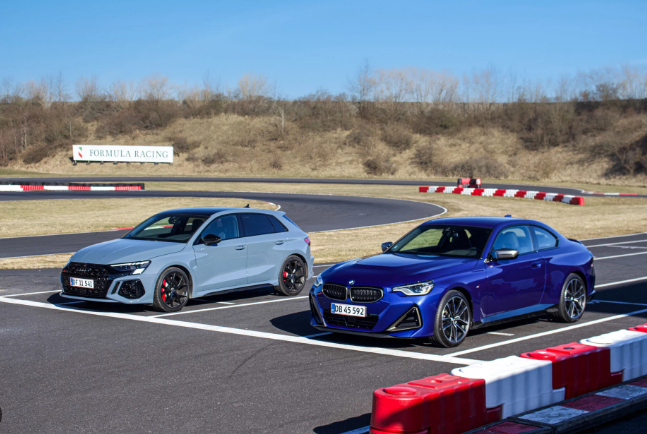
Architectural Foundations: Modern Chassis Engineering
To understand how these two machines handle demanding back roads, one must analyze their underlying structural platforms. Platform architecture dictates weight distribution, chassis rigidity, drive suspension geometry, and long-term driving dynamics.
+————————–+———————————+———————————+
| Specification | BMW M240i xDrive (2026) | Audi RS3 Sportback (2026) |
+————————–+———————————+———————————+
| Engine Architecture | 3.0L Turbo Inline-6 (B58 + MHEV)| 2.5L Turbo Inline-5 (TFSI) |
| Power Output | 382 hp / 369 lb-ft torque | 394 hp / 369 lb-ft torque |
| Drivetrain | Rear-biased xDrive AWD | quattro AWD with Torque Splitter|
| Platform | CLAR (Rear-Wheel Drive Native) | MQB evo (Front-Wheel Drive) |
| Curb Weight | 3,869 lbs (1,755 kg) | 3,450 lbs (1,565 kg) |
| Acceleration (0-60 mph) | 4.1 seconds | 3.6 seconds |
| Starting Price (approx.) | $52,000 (£50,000) | $63,000 (£62,000) |
+————————–+———————————+———————————+
BMW M240i xDrive: The CLAR Platform Advantage
The BMW M240i xDrive utilizes BMW’s modular Cluster Architecture (CLAR). This longitudinal engine layout is the same fundamental underpinning used in the larger M3, M4, and 3 Series saloons. Because it is natively engineered as a rear-wheel-drive platform, the balance of the chassis naturally favors rear-biased handling characteristics.
Weight Distribution: The front-to-rear weight bias stays remarkably close to BMW’s traditional 50:50 distribution model.
Chassis Stiffness: Substantial structural bracing across the front strut towers and underbody frame ensures exceptional torsional rigidity.
Mild-Hybrid Integration: The 48-volt mild-hybrid system provides instant low-end torque fill while smoothing out stop-start transitions during daily driving.
The trade-off for this premium longitudinal architecture is mass. Weighing in at 1,755 kg (3,869 lbs), the M240i xDrive is undeniably heavy for a compact two-door coupe. Managing that weight requires sophisticated dampening and substantial rubber.
Audi RS3: Maximizing the MQB evo Architecture
Audi approaches performance from a fundamentally different angle. The RS3 uses the transverse MQB evo platform, shared with mainstream hatchbacks across the Volkswagen Group. While a transverse layout can present nose-heavy weight distribution challenges, Audi Sport engineers have mitigated these drawbacks through aggressive chassis tuning and advanced active differential technology.
Torque Splitter Rear Axle: Replaces the traditional Haldex center-clutch pack with two individual electro-hydraulic multi-plate clutches on each rear driveshaft.
Dynamic Torque Vectoring: Up to 100% of rear-directed engine torque can be sent specifically to the outside rear wheel during hard cornering to eradicate understeer.
Lightweight Construction: Tipping the scales at 1,565 kg (3,450 lbs), the RS3 carries roughly 190 kg (418 lbs) less weight than the BMW M240i.
Powertrain Benchmark: Inline-Six vs. Five-Cylinder Engine
The beating heart of any performance vehicle is its engine. Both BMW and Audi offer legendary, multi-cylinder turbocharged powerplants that set them apart in a market increasingly dominated by generic 2.0-liter four-cylinder units.
BMW B58: The Gold Standard of Turbocharged Engines
Under the elongated hood of the M240i sits the updated B58 3.0-liter turbocharged inline-six engine, now integrated with a 48V mild-hybrid setup. Pushing out 382 horsepower (387 PS) and 369 lb-ft of torque, this engine is celebrated for its velvet-smooth power delivery, tuning potential, and real-world fuel economy.
The B58 relies on a twin-scroll turbocharger, high-precision direct injection, and BMW’s Valvetronic variable valve lift system. Torque comes on low in the rev range—starting under 2,000 RPM—making the M240i feel effortlessly fast in every gear. Power flows through an ZF 8-speed torque-converter automatic transmission, offering smooth auto-shifting during urban commuting and rapid gear changes when operated manually via paddle shifters.
Audi 2.5 TFSI: An Iconic Five-Cylinder Masterpiece
The Audi RS3 houses one of the most distinctive internal combustion engines ever built: the 2.5-liter five-cylinder TFSI. Generating 394 horsepower (400 PS) and an identical 369 lb-ft of torque, this engine features a unique 1-2-4-5-3 firing order that yields an unmistakable acoustic signature reminiscent of Audi’s legendary Group B rally cars.
Unlike the smooth, linear progression of BMW’s B58, Audi’s five-cylinder delivers an explosive mid-range punch. Linked to a 7-speed S tronic dual-clutch transmission (DCT), gear changes are near-instantaneous. The dual-clutch gearbox gives the RS3 a distinct edge in rapid-fire acceleration, propelling it from 0 to 60 mph in a blistering 3.6 seconds, comfortably outpacing the M240i’s 4.1-second sprint.
Driving Dynamics, Suspension, and Handling on Real Roads
When pushed hard on demanding, uneven rural roads, the core dynamic differences between a sports coupe and a hyper-hatch become immediately obvious.
+—————————————+
| DRIVING DYNAMICS |
+—————————————+
|
+———————-+———————-+
| |
v v
+—————————+ +—————————+
| BMW M240i xDrive | | Audi RS3 |
| (Rear-Biased GT Coupe) | | (Hyper-Hatch Weapon) |
+—————————+ +—————————+
| Progressive rotation | | Devastating lateral grip|
| GT-style highway poise | | RS Torque Splitter drift|
| Compliance over bumps | | Aggressive turn-in |
| Slightly isolated steer | | Point-and-shoot agility |
+—————————+ +—————————+
Corner Entry, Rotation, and Steering Feedback
Approaching a tight bend reveals the true nature of both chassis configurations:
The BMW M240i Perspective: The seating position is low, near the rear axle, giving the driver an immediate connection to rear-wheel movement. Turn-in response is progressive, with the variable sport steering feeling weighted and predictable. When accelerated out of a corner, the xDrive system biases torque to the rear wheels, allowing the rear end to rotate gently under power before the front wheels pull the car straight.
The Audi RS3 Perspective: The RS3 turns in with sharp agility, aided by wider front tires than rear tires—a rare setup that counteracts nose heaviness. Where older Audi models were criticized for understeer at the limit, the current RS3 rotates with enthusiasm thanks to the active rear torque splitter. Engaging RS Performance or RS Torque Rear mode turns the car into a hyper-agile cornering weapon that rotates instantly on turn-in.
Suspension Tuning and Road Compliance
Ride quality is critical for vehicles intended for daily driving duties.
BMW M240i: Features Adaptive M Suspension with electronically controlled dampers. In Comfort mode, it glides over road imperfections with impressive grand-tourer composure. In Sport mode, vertical body movement is strictly controlled, though the car’s 1,755 kg mass requires firm dampening that can make rough tarmac feel busy.
Audi RS3: Outfitted with RS Sport Suspension Plus featuring Dynamic Chassis Control (DCC). The damper settings offer a wide spread between daily usability and track-focused stiffness. While firm in its most aggressive modes, the system processes high-frequency bumps with exceptional poise, keeping all four tires planted over uneven surface changes.
Interior Craftsmanship, Practicality, and Everyday Usability
Owning a modern performance car requires a balance between speed and daily usability. Both vehicles offer premium cabins equipped with modern infotainment systems, but their layout philosophies differ significantly.
BMW M240i: Classic Coupe Elegance with Curved Displays
Step inside the BMW M240i coupe, and you are enveloped in a classic driver-focused cockpit.
Infotainment & Controls: The cabin features BMW’s Curved Display, combining a 12.3-inch digital instrument cluster and a 14.9-inch central display running iDrive 8.5. The system offers crisp graphics, customizable widgets, and seamless wireless Apple CarPlay and Android Auto integration.
Material Quality: Premium Vernasca leather seating, soft-touch plastics, and ambient cabin lighting create an upscale environment.
Seating & Cargo: Front seat space is generous, offering supportive side bolsters for spirited driving. However, the rear 2+2 seats are tight, best suited for small children or extra luggage. Trunk capacity stands at a practical 390 liters.
Audi RS3: Motorsport Aesthetics and Five-Door Versatility
The Audi RS3 cabin balances motorsport-inspired accents with five-door practicality.
Infotainment & Controls: Audi’s Virtual Cockpit Plus remains a benchmark for digital displays, featuring exclusive RS-specific tachometers, shift lights, and g-force meters. The central 10.1-inch MMI touch screen is integrated cleanly into the dash. Physical HVAC controls are retained below the screen, providing quick adjustment while driving.
Material Quality: Nappa leather sports seats with honeycomb stitching, an Alcantara-wrapped steering wheel, and carbon-fiber trim highlights convey a race-inspired atmosphere.
Seating & Cargo: Thanks to its hatchback form factor, the RS3 easily accommodates four adults with comfortable rear head and legroom. The rear hatchback opening provides superior versatility for loading large items, despite total luggage volume measuring roughly 282 liters behind the rear seats due to the rear differential packaging.
Cost of Ownership, Insurance, and Long-Term Value
Evaluating the total financial commitment of operating high-performance European vehicles requires looking beyond the initial sticker price. Financing terms, residual values, auto insurance brackets, and long-term maintenance costs all impact ownership expenses.
Purchase Price and Depreciation Trends
BMW M240i xDrive: Starting near £50,000 ($52,000 US equivalent), the M240i represents an outstanding balance of performance per dollar. Because it occupies a segment with few direct two-door rivals, its depreciation curve remains stable, holding strong residual value over a typical three-to-four-year lease cycle.
Audi RS3: Priced at approximately £62,000 ($63,000 US equivalent), the RS3 requires a significant financial step up. However, full-bore Audi Sport RS models typically experience slower depreciation than standard S models due to lower production volumes and high demand on the secondary enthusiast market.
Insurance Costs, Vehicle Financing, and Maintenance
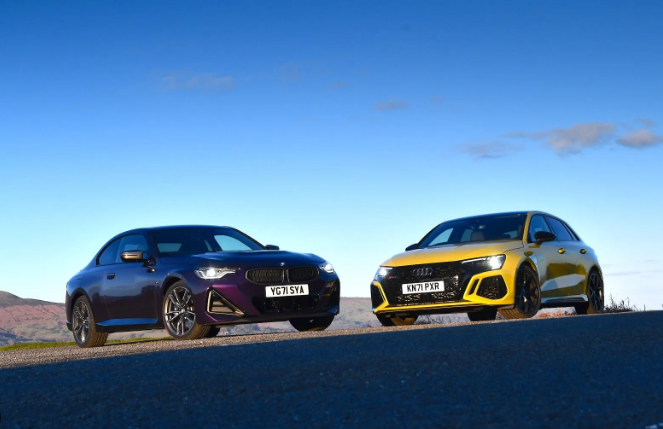
Auto Insurance Premiums: Both cars fall into higher vehicle insurance rating groups due to their acceleration capabilities and repair complexity. Drivers should obtain auto insurance quotes prior to purchase, as high-value performance vehicles with advanced radar-assisted safety equipment can carry elevated annual premiums.
Auto Loans and Financing: Buyers financing through auto loans should compare dealership promotional APR rates against traditional credit union auto loans. Given higher prevailing auto loan interest rates, securing competitive auto financing options can save thousands over a 48 or 60-month term.
Routine Service & Repairs: Scheduled vehicle maintenance for both models includes high-performance synthetic oil changes, brake fluid flushes, and differential fluid replacement intervals. Audi’s dual-clutch transmission require periodic fluid services, whereas BMW’s ZF 8-speed automatic service intervals are slightly less frequent under normal operating conditions.
Final Verdict: Which Performance Icon Deserves Your Garage Space?
Choosing between the 2026 BMW M240i xDrive and the Audi RS3 ultimately depends on your driving priorities, budget constraints, and desired vehicle format.
+—————————————————————————————+
| WHICH SHOULD YOU BUY? |
+—————————————————+———————————–+
| CHOOSE THE BMW M240i xDrive IF: | CHOOSE THE AUDI RS3 IF: |
+—————————————————+———————————–+
| You want a traditional rear-biased sports coupe | You demand maximum acceleration |
| You prefer a smooth, refined inline-6 engine | You want an iconic 5-cylinder |
| You value long-distance GT highway comfort | You need 5-door usability |
| You want maximum performance under £50,000 | You seek ultimate track grip |
+—————————————————+———————————–+
The BMW M240i xDrive is one of the premier sports coupe values on the market today. It blends classic longitudinal rear-biased dynamics, an exceptional six-cylinder engine, and high-end luxury refinement into a daily-driver package that punches well above its weight class. If you want a stylish two-door sports car that delivers 90% of the capability of an M2 at a much more accessible price point, the M240i is an outstanding choice.
On the other hand, the Audi RS3 remains the undisputed king of hyper-hatches. Its explosive 2.5-liter five-cylinder engine, lighter curb weight, and advanced torque-vectoring rear differential elevate its dynamic ceiling beyond what the heavier M240i can achieve when driven flat-out. It justifies its £12,000 premium with supercar-slaying acceleration, five-door everyday practicality, and an unforgettable exhaust note.
Ready to Experience Ultimate Performance?
If you are evaluating your next vehicle purchase, the best way to decide is from behind the wheel. Schedule a test drive at your local authorized dealership today, request personalized auto loan rates, and compare car insurance options to find the ideal sports coupe or performance hatch tailored to your lifestyle.