
The End of an Icon: Bugatti Assembles the Final W-16 Mistral as the V-16 Tourbillon Era Begins
For over two decades, the hypercar landscape has been dominated by a singular engineering marvel: Bugatti’s quad-turbocharged W-16 engine. Born from an ambitious dream to redefine automotive capabilities, this legendary 8.0-liter powerplant set absolute benchmarks for speed, luxury, and mechanical prestige. Today, that historic chapter officially draws to a close. Inside the quiet atelier in Molsheim, France, Bugatti master artisans have completed the final production unit of the W-16 roadster, the Mistral—marking the end of an unparalleled multi-cylinder legacy and opening the door to an electrified high-performance future.
As an industry observer who has tracked exotic automotive developments for ten years, witnessing the sunset of this quad-turbo W-16 is a bittersweet milestone. The transition represents more than a simple engine swap; it marks a monumental pivot in hypercar investment, automotive engineering, and luxury vehicle collection strategies worldwide.
The Final Chapter: Chassis No. 99 “The Last of Its Kind”
To commemorate the grand finale of its road-going W-16 engine, Bugatti bestowed a unique designation upon the 99th and final W-16 Mistral: “The last of its kind.” While Bugatti famously produced 500 units of the fixed-roof Chiron, the Mistral roadster was intentionally limited to just 99 bespoke examples worldwide, making it an exceptionally rare piece of automotive history.
Engineered as the ultimate open-top hypercar, the Mistral achieved legendary status long before the final unit rolled off the assembly line. Powered by the ultimate 1,578-horsepower iteration of the quad-turbo W-16, the model carved its name into history by capturing the world record for the fastest open-roof production vehicle, achieving a verified top speed of 282 mph at the Papenburg proving grounds.
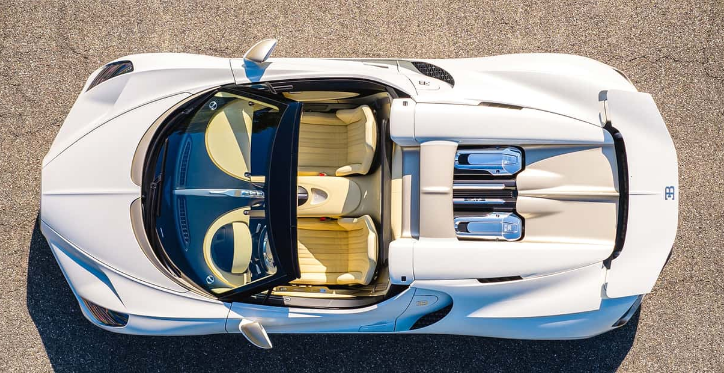
This specific milestone chassis showcases an extraordinary level of tailored craftsmanship:
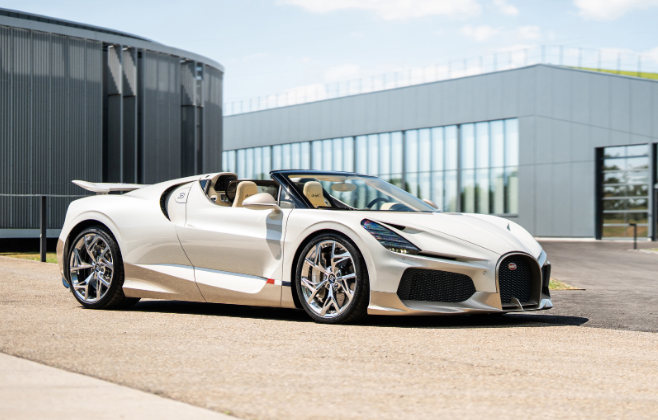
Exterior Finish: Adorned in a subtle yet complex two-tone Pearl and Sparkle exterior palette that captures light dynamically across the roadster’s aggressive, sculpted aerodynamic surfaces.
Interior Tailoring: Styled with a refined Magnolia leather scheme contrasted against matte grey carbon-fiber elements throughout the cabin.
Historical Homages: Ettore Bugatti’s iconic personal signature is meticulously etched into the integrated headrests, aluminum door sill plates, and the hand-finished engine cover.
Bespoke Glasswork: Positioned prominently on the central armrest rests a frozen crystal glass plate bearing the inscription “Spirit of the Wind.” Created in partnership with renowned French crystal house Lalique, this detail honors a century-old lineage of artistic collaboration.
While recently revealed collector commissions like the porcelain-infused Blanc Eternal emphasized pure aesthetic extravagance, chassis No. 99 represents a profound emotional milestone. It signals the complete retirement of Bugatti’s iconic quad-turbo flagship from standard street-legal production models.
The Legacy of the Quad-Turbo W-16 Architecture
When Bugatti unveiled the Veyron 16.4 in the mid-2000s, critics questioned whether a 1,000-horsepower, sixteen-cylinder engine could ever remain reliable under real-world driving conditions. Engine designers solved extreme thermodynamic challenges by arranging four banks of four cylinders in a staggered “W” configuration around a shared crankshaft, pressure-fed by four massive turbochargers.
Over twenty years of meticulous development, the W-16 architecture evolved from a 987-horsepower engineering experiment into a 1,578-horsepower hypercar icon powering the Veyron, Chiron, Divo, Centodieci, Bolide, and finally, the Mistral. It effectively redefined high-end collector car values and set new standards for luxury auto insurance, specialized vehicle transport, and high-net-worth automotive investments.
+——————-+——————–+——————–+
| Vehicle Model | Total Production | W-16 Output (HP) |
+——————-+——————–+——————–+
| Bugatti Veyron | 450 Units | 987 – 1,183 HP |
| Bugatti Chiron | 500 Units | 1,479 – 1,578 HP |
| Bugatti Mistral | 99 Units | 1,578 HP |
+——————-+——————–+——————–+
While Bugatti’s official language carefully notes that this completion ends the engine’s “road-going story”—leaving a narrow window for future track-only or one-The End of an Icon: Bugatti Assembles the Final W-16 Mistral as the V-16 Hybrid Era Begins
Having spent over a decade tracking hypercar engineering, watching the final iteration of a benchmark powertrain roll off the line is always a monumental moment. In Molsheim, France, an unforgettable chapter in automotive history has just drawn to a close. Bugatti has officially completed production of the very last W-16 powered road car: the 99th Bugatti Mistral.
Dubbed “The last of its kind,” this specific unit marks the absolute climax of Bugatti’s quad-turbocharged 8.0-liter W-16 engine—a mechanical masterpiece that defined ultra-luxury automotive performance for two decades. As collectors and investors pivot toward high-value exotic car acquisitions, the retirement of this legendary powerplant signals a massive shift in the hypercar market. Moving forward, the brand is stepping into the electrified future with a naturally aspirated V-16 hybrid powertrain, debuting in the all-new Tourbillon.
For automotive enthusiasts, luxury car investment funds, and prospective hypercar buyers, this transition represents both the end of pure mechanical excess and the dawn of a new era in high-performance automotive engineering.
The Legacy of Bugatti’s Quad-Turbo W-16 Engine
To understand the weight of this final assembly, one must look back at what the W-16 achieved. When Volkswagen Group resurrected Bugatti, the mandate was simple yet seemingly impossible: build a road car with over 1,000 horsepower that could exceed 250 mph while offering the comfort of a grand tourer. The answer was four banks of four cylinders arranged around a single crankshaft, fed by four massive turbochargers.
From the original Veyron 16.4 to the Chiron and its hyper-exclusive derivatives, the quad-turbo W-16 became the gold standard of hypercar engineering. Over its lifespan, output scaled from 987 horsepower to an astonishing 1,578 horsepower in vehicles like the Chiron Super Sport 300+ and the Mistral itself.
Key milestones of the W-16 engine architecture include:
Engineering Feat: A unique 8.0-liter displacement utilizing two narrow-angle V8 blocks set on a common crankshaft.
Heat Management: A custom cooling network featuring multiple radiators to stabilize thermal loads during top-speed runs.
Unrivaled Records: The architecture propelled Bugatti vehicles past the 250 mph, 300 mph, and 280 mph (open-top) barriers.
The Mistral was designed specifically as a swan song for this engine. Limited to just 99 examples worldwide, it gave the W-16 a dedicated, open-cockpit platform. By comparison, Bugatti produced 500 units of the Chiron, making the Mistral significantly rarer and instantly cementing its status among elite car collectors seeking high-yield luxury assets.
Inside Chassis No. 99: “The Last of Its Kind”
The final Mistral to exit the Molsheim Atelier was custom-commissioned with hyper-detailed craftsmanship. Finished in a bespoke two-tone paint scheme known as Pearl and Sparkle, the exterior subtlely shifts under natural light, offering a sophisticated contrast to the hyper-aggressive aerodynamic lines of the roadster.
Inside, the cabin is trimmed in high-grade Magnolia leather contrasted with Grey Carbon Matt accents. The level of personalization highlights Bugatti’s Sur Mesure program, which caters to high-net-worth clients demanding absolute uniqueness.
Notable bespoke elements on this final unit include:
Ettore Bugatti Signatures: Etched onto the leather headrests, polished aluminum door sills, and the engine bay trim.
Lalique Crystal Collaboration: A hand-crafted frozen crystal glass plate embedded into the center armrest, featuring the “Spirit of the Wind” motif—a direct nod to the historic partnership between Bugatti and legendary French glassmaker Lalique.
Aerodynamic Record Holder: The open-roof platform remains the world’s fastest roadster, having clocked a validated 282 mph top speed at the Papenburg test track in Germany.
While recently revealed one-offs like the porcelain-infused Chiron Super Sport “Blanc Éternel” pushed artistic boundaries, Chassis No. 99 carries unprecedented historical weight. It is not just another custom build; it is the absolute final road-going application of the 16-cylinder engine that reshaped modern automotive history.
Top Speed and Performance Dynamics: The W-16 Mistral Specifications
The Bugatti Mistral was never intended to merely be a static showpiece. It was engineered to deliver raw, unfiltered open-air performance that pushed the boundaries of automotive physics.
| Specification Feature | Bugatti W-16 Mistral Details |
|---|---|
| Engine Configuration | 8.0-Liter Quad-Turbocharged W-16 |
| Horsepower Output | 1,578 hp (1,600 PS) |
| Torque Rating | 1,180 lb-ft (1,600 Nm) |
| Top Speed Record | 282 mph (453.91 km/h) |
| Transmission | 7-Speed Dual-Clutch Automatic |
| Production Run | 99 Units Worldwide |
| Drivetrain | Permanent All-Wheel Drive (AWD) |
Achieving 282 mph without a fixed roof required comprehensive structural rigidity enhancements and entirely reworked airflow channels. Ram-air induction scoops mounted directly behind the occupants’ heads fed cool air into the monster W-16 engine while acting as integrated rollover protection.
Hypercar Investment Analysis: W-16 Collectors’ Market
From a financial perspective, the closing of the W-16 order books has sent shockwaves through high-end automotive auctions and private sales markets. High-net-worth investors and collector car funds constantly seek vehicles that combine mechanical significance, extreme scarcity, and brand prestige. The final W-16 Mistral checks every single box.
When assessing exotic car value retention and appreciation potential, several market variables come into play:
Scarcity and Rarity: With only 99 units built, the Mistral is five times rarer than the Chiron. Limited production runs historically correlate with faster capital appreciation on the secondary market.
Historical Milestone: End-of-era models—particularly those representing the final iteration of a internal combustion architecture—typically command a massive premium over mid-cycle production vehicles.
Collector Demand: As electric vehicles and downsized hybrid powertrains become mandatory across global markets, pure high-displacement multi-cylinder engines are increasingly viewed as blue-chip physical assets.
Insuring, maintaining, and managing these ultra-high-net-worth assets requires specialized exotic auto finance strategies, bespoke wealth management solutions, and specialized luxury vehicle insurance coverage. For elite collectors, acquiring a final-edition hypercar isn’t just about driving—it’s an asset class diversification strategy.
Transitioning to La Manufacture: The New V-16 Hybrid Era
While Bugatti carefully worded its announcement to state that this marks the end of the W-16’s road-going story—leaving the door open for track-only, non-homologated projects—the factory’s core focus has fully pivoted to the future.
Just days before the final Mistral completed assembly, Bugatti inaugurated its state-of-the-art production facility extension in Molsheim: La Manufacture. This site was constructed specifically to build the next-generation hypercar, the Bugatti Tourbillon.
The mechanical shift is drastic:
Out: The 8.0-liter quad-turbocharged W-16 engine.
In: An 8.3-liter naturally aspirated V-16 engine developed alongside Cosworth, paired with a high-performance triple-electric-motor hybrid system.
The new hybrid platform produces a combined 1,800 horsepower while revving up to a staggering 9,000 RPM. By transitioning from turbocharging to high-revving natural aspiration coupled with electric torque vectoring, Bugatti aims to deliver instant throttle response while meeting evolving international emissions regulations.
This pivot demonstrates how luxury automotive manufacturers are leveraging high-performance hybrid tech to preserve raw, multi-cylinder mechanical soul in an increasingly electrified regulatory landscape.
Engineering Legacy: W-16 vs. V-16 Hybrid Comparison
The technical evolution between the outgoing platform and the incoming powertrain highlights how hypercar design philosophy has transformed over the past two decades.
Forced Induction vs. Hybridization: The W-16 relied on four massive turbochargers to compress air and generate force, creating massive mid-range torque. The new V-16 uses high-rpm natural aspiration for atmospheric sound and high-end power, while low-end torque is instantly filled by front and rear electric drive units.
Weight Management: The heavy quad-turbo layout required extensive cooling systems. The hybrid architecture shifts weight distribution by integrating a lightened Cosworth engine block alongside high-density battery packs integrated directly into the carbon-fiber monocoque.
Cockpit Ergonomics: While the Chiron and Mistral featured digital-analog hybrid gauge clusters, the new Tourbillon takes inspiration from high-end horology, featuring fully mechanical Swiss-designed titanium instrument clusters.
This evolution ensures that while the iconic quad-turbo engine rests, Bugatti’s commitment to mechanical art and extreme speed remains completely uncompromised.
The Future of Ultra-Luxury Hypercars
The completion of the final Bugatti W-16 Mistral represents a seismic moment for the automotive industry. It officially concludes an era defined by pure, unadulterated internal combustion engineering—a time when four turbochargers and sixteen cylinders reigned supreme atop the speed charts.
As La Manufacture prepares for the first customer deliveries of the V-16 Tourbillon, the collector community continues to watch closely. The final 99 Mistral owners now hold the keys to one of the most historic chapters in performance history, securing a place in automotive legend that will likely never be replicated.
Whether you are looking to track the evolving hypercar resale market, explore exotic car financing options, or stay ahead of cutting-edge automotive technology trends, the transition from W-16 to V-16 hybrid power is a masterclass in modern luxury engineering.
Are you looking to stay updated on the latest shifts in the hypercar market, rare vehicle auctions, and automotive investment strategies? Connect with our team of industry experts today to receive exclusive insights, market analysis, and advisory services tailored for high-net-worth automotive enthusiasts.