
The Ultimate Carrera Showdown: Porsche 992 GTS vs 997 GTS in the Modern Era
If you have spent any significant time around luxury sports cars over the last decade, you already know that the automotive landscape is shifting at breakneck speed. As we navigate through 2025, the internal combustion engine is sharing the stage with electrification, leading to some of the most fascinating engineering milestones in automotive history. For driving purists and collectors alike, the conversation inevitably turns to Stuttgart. Today, we are looking at a generational clash that defines the trajectory of the modern sports car: the Porsche 992 GTS vs 997 GTS.
To understand the sheer magnitude of the newly released Porsche 992 GTS T-Hybrid, we have to look in the rearview mirror at the car that started this specific lineage. The GTS badge has always represented the sweet spot in the Carrera lineup—the perfect bridge between a daily drivable Carrera S and the track-weaponized GT3. But how does the analog charm of the original water-cooled 997 GTS stack up against the hybrid-assisted, hyper-fast reality of the Porsche 992 GTS? As an industry veteran who has spent the last ten years testing, analyzing, and writing about high-performance vehicles, I set out to find out exactly how much the game has changed.
The Birth of an Icon: What Made the 997 GTS Special
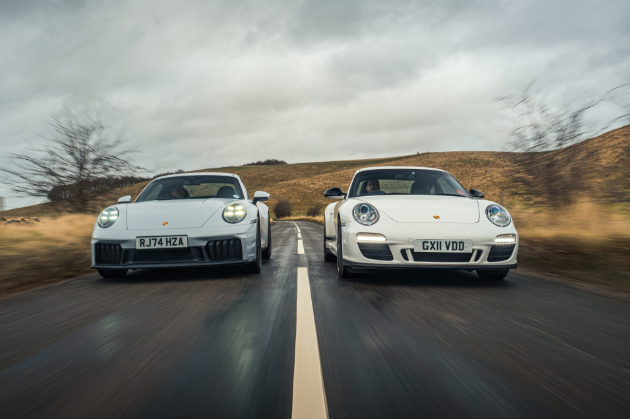
There must have been a celebratory mood in the boardroom at Stuttgart when they first conceptualized the modern Carrera GTS. Back in the late 2000s, Porsche needed a strategy to gracefully phase out the 997 generation before introducing the all-new 991 chassis, which would bring controversial changes like electric power steering and a longer wheelbase. While limited-run specials like the GT3 RS 4.0, the GT2 RS, and the Speedster were capturing magazine covers, the brand needed a volume seller to keep showroom floors busy and exotic car financing applications flowing.
The solution was a masterstroke of parts-bin engineering. They dusted off the GTS moniker—originally made famous by the legendary 904 GTS racer in the 1960s and later the 928 GTS grand tourer—and started pulling premium components from the factory shelves. The original 997 GTS was the first non-Motorsport 911 to pair the aggressive wide-body shell of the Carrera 4 with a purist-focused rear-wheel-drive layout.
Porsche engineers smartly bypassed the hardcore GT3 components, keeping the car street-friendly. Instead, they took the naturally aspirated 3.8-liter flat-six and applied the coveted X51 Powerkit, pushing output to a healthy 408 horsepower. They threw in a sports exhaust system, PASM adaptive suspension, and unique center-lock alloy wheels. Inside, drivers were treated to an Alcantara-heavy cabin and a Sport Design steering wheel. At the time, the premium to upgrade from a standard Carrera S to the GTS was barely over $3,000—a modest upcharge that created one of the best luxury sports car investment opportunities of the modern era. Today, finding a well-maintained used Porsche 911 for sale from this specific vintage commands a massive premium on the secondary market.
Enter the T-Hybrid Era: The Porsche 992 GTS
Fast forward to today, and the philosophy behind the GTS moniker has shifted dramatically. The Porsche 992 GTS is no longer just a run-out special packed with value options; it is a technological pioneer. For the 2025 model year, the Porsche 992 GTS introduces the T-Hybrid system, radically altering the performance DNA of the Carrera lineup.
While a current Carrera S relies on a traditional twin-turbocharged 3.0-liter flat-six producing 473 horsepower, the Porsche 992 GTS utilizes a brand-new 3.6-liter single-turbo engine paired with an innovative hybrid system. The result? A staggering 533 horsepower and 450 lb-ft of torque. To put that into perspective, the new Porsche 992 GTS produces more power than the flagship 997 Turbo S did just over a decade ago.
This technological leap is not just about raw output; it is about how that power is delivered. The hybrid electric motor integrated into the transmission, paired with an electrically assisted turbocharger, effectively eliminates turbo lag. The Porsche 992 GTS hits 60 mph 0.3 seconds faster than its predecessor, a massive margin in the traction-limited realm of rear-wheel-drive sports cars.
However, progress comes with a price tag. The financial leap from a Carrera S to a Porsche 992 GTS is now a gaping chasm, running well over $15,000, though it now includes rear-axle steering as standard equipment. This price point pushes the car into a highly competitive bracket, where buyers are routinely comparing exotic car financing options and negotiating luxury auto insurance rates just to put one in the garage. Yet, demand is off the charts. The Porsche 992 GTS has evolved from a clever marketing package into the most critical sub-brand in the company’s portfolio.
A Mid-Spec Model with Supercar Power
The moment you slide into the heavily bolstered bucket seats of the Porsche 992 GTS, the driving experience rewrites your expectations. Everyone who drives the new T-Hybrid steps out of the cabin with the exact same wide-eyed realization: this car is violently fast. During my initial testing of the Porsche 992 GTS along the sweeping coastal highways of Los Angeles, the immediate throttle response was intoxicating.
Because the T-Hybrid system fills the torque gaps traditionally left by exhaust-driven turbos, the initial launch off the line actually feels more immediate than a current 911 Turbo S. In my four days evaluating the car, not once did I find myself wishing for more horsepower. It dominates highway on-ramps and tight canyon straights with a level of ferocity that makes you question what Porsche engineers could possibly be saving for the next generation of GT models.
Of course, the integration of the hybrid system has led to one controversial casualty: the manual transmission. Because the electric drive unit is seamlessly integrated into the 8-speed PDK dual-clutch gearbox, a traditional three-pedal setup is physically impossible for the Porsche 992 GTS. For driving purists looking for top-tier sports car financing on a brand-new manual 911, this is a bitter pill to swallow, though the sheer relentless speed of the PDK makes a strong argument for the compromise.
Versatility Meets Raw Speed
Despite its supercar-baiting performance metrics, the Porsche 992 GTS remains a remarkably versatile machine. It possesses a dual personality that makes it incredibly appealing for high-net-worth individuals looking for a daily driver in traffic-heavy cities like Miami or Los Angeles.
Leave the drive mode in ‘Normal,’ and the Porsche 992 GTS settles into a refined, comfortable cadence. The fully digital instrument cluster is sleek and intuitive, offering seamless Apple CarPlay integration and easy shortcuts to disable the increasingly intrusive modern driver-assistance systems. Even with aggressive Goodyear tires and reduced sound deadening, it is a car you could happily drive to the office every single day.
But twist the steering-wheel-mounted drive dial to ‘Sport Plus,’ and the Porsche 992 GTS transforms. The throttle map sharpens to a razor’s edge. I highly recommend taking control via the paddle shifters when pushing hard; left to its own devices in automatic mode, the gearbox is almost too eager to drop three gears at the slightest throttle input, seemingly unaware of the massive wave of hybrid torque available in the mid-range. When you take command of the shifts and press the accelerator to the firewall, the Porsche 992 GTS delivers a brutal, breathless surge of acceleration that blurs the scenery in a way a “mid-tier” Carrera never has before.
Behind the Wheel of the Analog Icon: The 997 GTS
So, how does a fifteen-year-old sports car defend itself against this modern hybrid titan? To find out, I secured the keys to a pristine, low-mileage 997 GTS. Configured in the most desirable spec imaginable—a rear-wheel-drive coupe with a six-speed manual transmission—this car represents the absolute zenith of the analog Carrera era.
Walking up to the 997 GTS, its footprint feels incredibly compact by 2025 standards. While the design has aged gracefully, the rear styling undeniably belongs to an earlier era—a reminder that this core chassis architecture debuted in the late 1990s. The cabin is wonderfully simple. There are no massive touchscreens dominating the dashboard, just an Alcantara-wrapped steering wheel, physical climate control dials, and the classic five-gauge instrument cluster with the tachometer placed dead center. You even have to insert a physical key into the ignition slot on the left side of the steering column to fire it up.
Engaging the clutch and shifting into first gear immediately highlights what the modern era has sacrificed in the name of outright speed. The mechanical, oily, mechanical throw of the 997’s manual gearbox is a tactile masterpiece, a sensation you cannot find in any modern Carrera outside of a GT3.
The 3.8-liter naturally aspirated flat-six fires up with a mechanical clatter that settles into a smooth, refined idle. Compared to the bass-heavy, engineered exhaust note of the Porsche 992 GTS, the older engine is quieter at low RPMs but infinitely more characterful as it climbs the rev range. Down low, the torque is adequate, but it lacks the chest-compressing punch of the hybrid. In fact, up to 6,000 RPM, the 997 GTS doesn’t feel substantially faster than a standard Carrera S from the same era. But keep your foot pinned, and magic happens. A resonance flap in the intake manifold snaps open, the engine takes a deep breath, and the car screams aggressively toward its 7,300 RPM redline.
Performance Comparison: The Porsche 992 GTS vs 997 GTS
Evaluating the Porsche 992 GTS vs 997 GTS on twisting mountain roads reveals a fascinating contrast in automotive philosophy. The biggest dividing line between the two is weight. The modern Porsche 992 GTS is a physically larger vehicle carrying heavy hybrid hardware, a battery pack, massive brakes, and complex rear-axle steering systems. The 997 GTS, by comparison, weighs nearly 400 pounds less.
That weight difference, combined with a much shorter wheelbase and hydraulic power steering, makes the 997 GTS feel incredibly lithe and communicative. Driving it through sweeping canyon curves is an exercise in joy. The hydraulic steering chatters constantly, telling your fingertips exactly what the front tires are doing over imperfections in the asphalt. It is not about outright cornering speeds; it is about the accessibility of the experience. You can wring out the 997 GTS, rev-matching downshifts and feeling the chassis pivot beneath you, without risking your driver’s license.
On those exact same canyon roads, the Porsche 992 GTS feels distinctly oversized and frustratingly constrained. The limits of the new hybrid chassis are so astronomically high that you can only tap into a fraction of its potential on public pavement. You are reduced to executing violent, two-second bursts of acceleration between corners before slamming on the massive carbon-ceramic brakes. The Porsche 992 GTS is a technological marvel that demands a proper racetrack to truly stretch its legs, whereas the 997 GTS makes a 45-mph backroad feel like the final lap at Le Mans.
A Brief Word on Extreme Precision: The 911 S/T
If you are a well-heeled buyer currently perusing luxury sports car dealerships, you might also be looking at ultra-exclusive modern options like the 911 S/T to capture that analog feel. During a recent test of a gorgeous, tweedy-interior S/T, I was expecting the ultimate modern driving nirvana. However, real-world conditions quickly intervened.
On damp, early-morning asphalt, the S/T’s aggressive Michelin Pilot Sport Cup 2 track tires made the car incredibly spiky and nervous. Unlike the predictable, progressive breakaway of the 997 GTS, the S/T on cold, damp track rubber was a constant exercise in catching sudden traction loss. It highlighted a growing trend in modern high-performance vehicles: engineers are chasing limits that are completely inaccessible in everyday driving. If I were financing a million-dollar S/T, my first stop would be a tire shop to mount high-performance street rubber that actually functions safely when the clouds roll in.
The Verdict on the Ultimate GTS
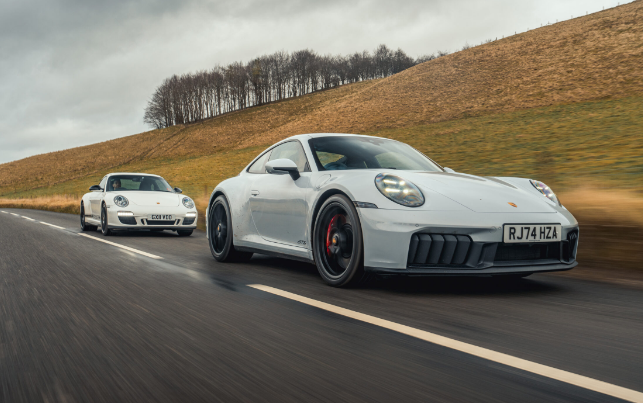
When it comes down to the wire in the battle of the Porsche 992 GTS vs 997 GTS, there are no losers, only drastically different interpretations of speed. The new Porsche 992 GTS T-Hybrid is an absolute triumph of automotive engineering. It is brutally fast, technologically brilliant, and incredibly comfortable for daily use. It proves that the transition toward electrification does not have to mean the death of driving excitement. It is, without question, the most capable daily-drivable sports car on the market today.
Yet, there is a reason that analog sports car depreciation is virtually non-existent for models like the 997 GTS. The older car provides a mechanical intimacy, a lightness of touch, and a sheer joy of engagement that cannot be replicated by microchips and electric motors. It remains one of the greatest driver’s cars ever assembled in Stuttgart.
Whether you are looking to invest in a appreciating modern classic, or you are ready to experience the bleeding edge of hybrid sports car performance, the GTS badge remains the gold standard. Ready to experience the difference for yourself? Reach out to your local premier luxury auto brokerage today to schedule a track-day test drive or explore bespoke exotic car financing options to put one of these incredible machines in your driveway.