



The Holy Grail of Analog V12s: Why the 2000 Lamborghini Diablo GT Represents the Apex of Raw Supercar Engineering
Having evaluated high-end exotic automobiles and navigated the luxury car auction market for over a decade, I have witnessed seismic shifts in collector preferences. While modern hypercars dazzle us with dual-clutch transmissions, hybrid battery packs, and complex electronic driver aids, an undeniable truth has resurfaced across the automotive landscape: nothing captures the soul of motoring quite like a raw, high-displacement, naturally aspirated V12 paired with a gated manual gearbox.
As we navigate the current collector market, the demand for pure, unadulterated analog performance has reached an all-time high. Investors, seasoned collectors, and enthusiast drivers are turning their attention toward the golden era of supercars—the late 1990s and early 2000s. Standing triumphantly at the absolute pinnacle of this era is a machine of pure intimidation and engineering purity: the Lamborghini Diablo GT.
With only 80 numbered units ever leaving the legendary Sant’Agata Bolognese assembly line, the Lamborghini Diablo GT is not merely rare; it is an icon that bridged the gap between old-world Italian bravado and modern aerodynamic discipline. Now, as chassis number 74 prepares to cross the auction block at the prestigious Bonhams Laguna Seca sale, the global automotive community is bracing for what could be a watershed moment for late-model Diablo valuations.
If you are a serious collector considering adding this homologated track monster to your garage, or simply an enthusiast assessing the current luxury vehicle market, here is an in-depth expert breakdown of why this ultimate iteration of the Diablo remains one of the most compelling classic supercar investment opportunities today.
The Genesis of a Track-Focused Masterpiece
To understand the profound significance of the Lamborghini Diablo GT, one must first appreciate the challenging vacuum it was created to fill. Replacing an icon as culturally dominant and visually dramatic as the Marcello Gandini-designed Countach was an almost impossible assignment. When the original Diablo debuted in 1990, it had to prove that Lamborghini could retain its theatrical wedge aesthetic while introducing structural rigidity, refined ergonomics, and groundbreaking speed.
The standard Diablo successfully catapulted the marque into the modern age, earning the title of the first production Lamborghini capable of exceeding the mythical 200 mph threshold. Later, the inclusion of all-wheel drive in the VT variants broadened its usable performance profile. However, true purists, inspired by the brand’s aggressive motorsport pushes in the Supertrofeo series, yearned for something far more visceral—a street-legal weapon stripped of compromise.
In late 1999, Lamborghini answered that call by unveiling the Lamborghini Diablo GT at the Geneva Motor Show. It was designed from the outset as a motorsport-derived road car, drawing heavily on the extreme engineering of the GT1 racing program. Unlike standard production models, the Lamborghini Diablo GT was crafted with an uncompromising focus on weight reduction, thermal efficiency, and aggressive downforce.
At the time of its release, strict federal regulations rendered the model ineligible for straightforward road registration in North America. The factory produced only 80 examples, primary destined for European markets. For decades, American enthusiasts could only admire this aggressive variant from afar. However, because these vehicles are now hitting the 25-year milestone, the doors have swung wide open for U.S. collectors to legally import, register, and experience this extreme supercar on American roads without the operational constraints of historic “Show or Display” permits.
Unpacking the Mechanical Marvel: Engine, Aerodynamics, and Chassis Dynamics
What separates a standard Diablo from the coveted Lamborghini Diablo GT is not merely cosmetic bravado; it is a fundamental transformation of the vehicle’s mechanical infrastructure. Having analyzed numerous track-focused supercars over the years, I consider the GT’s mechanical updates to be a textbook example of purpose-driven engineering.
The Crown Jewel: The Expanded 6.0-Liter V12
At the heart of the Lamborghini Diablo GT lies a magnificent, naturally aspirated 6.0-liter V12 engine. To achieve this displacement, Lamborghini engineers increased the stroke of the standard 5.7-liter engine from 80 mm to 84 mm. Combined with multi-point electronic fuel injection, individual throttle bodies, titanium connecting rods, and a lightweight crankshaft, this revised powertrain generated an astonishing 567 horsepower at 7,300 RPM and 465 lb-ft of torque at 5,500 RPM.
In an era before instant electric motor torque vectoring, managing 567 mechanical horsepower required absolute respect from the driver. The exhaust system was tuned to deliver a deafening, high-pitched V12 symphony that remains completely unmatched by modern turbocharged powerplants.
Pure Rear-Wheel-Drive and Gated Manual Precision
In a deliberate effort to shed every non-essential pound, Lamborghini engineers completely bypassed the heavy viscous-clutch all-wheel-drive system found in the Diablo VT. Instead, all 567 horses were channeled exclusively to the rear wheels through a heavy-duty five-speed manual transmission equipped with a traditional open-gate shifter.
To handle the immense power output, the factory offered customizable gear ratios tailored to client preference, paired with a limited-slip rear differential. Driving a rear-wheel-drive, mid-engine V12 supercar of this magnitude demands exceptional car control, rewarding skilled drivers with an unfiltered connection to the tarmac that contemporary paddle-shift supercars simply cannot replicate.
Lightweight Composite Architecture and Advanced Aerodynamics
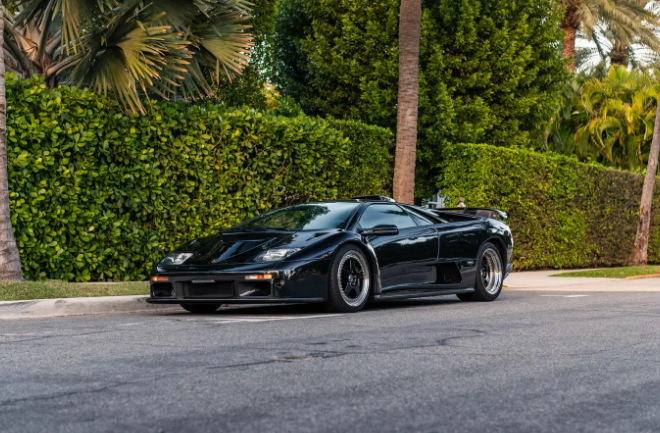
Virtually every exterior panel of the Lamborghini Diablo GT was redesigned to maximize track performance. The bodywork is constructed almost entirely from ultra-lightweight carbon fiber, with the exception of the steel roof (retained for structural rigidity) and aluminum doors for safety.
The body kit was not created for show—it was perfected in the wind tunnel. Key aerodynamic and cooling enhancements include:
Aggressive Front Fascia: Featuring a prominent front splitter and massive twin air intakes to channel cool air directly to the upgraded oil coolers.
Functional Carbon Fiber Hood Vent: Designed to extract hot air from the front radiator over the windshield, reducing front-end lift at triple-digit speeds.
Widened Front Fenders: Molded carbon fiber arches designed to accommodate a wider front track and larger rolling stock.
Roof-Mounted Engine Ram Air Intake: An iconic, functional scoop mounted atop the engine cover, force-feeding cool ambient air directly into the thirsty 6.0-liter V12 manifold.
Exposed Carbon Fiber Rear Diffuser and Adjustable Wing: A massive adjustable carbon rear spoiler combined with a complex underbody diffuser to ensure high-speed stability through fast sweeping corners.
Spotlight on Chassis #74: A Masterclass in Collector Provenance
The specific example featured at the upcoming Bonhams Laguna Seca event is chassis number 74 out of the 80 produced—making it one of the final units ever hand-built at the Sant’Agata factory.
Exterior and Interior Specification
Finished in the strikingly menacing factory shade known as Black Rage (Nero), this Lamborghini Diablo GT projects an unmistakable road presence. The deep gloss black paint accentuates the raw carbon fiber aerodynamic components, creating a visual balance between luxury and brutal motorsport purpose.
Steering clear of excessive wear, the interior maintains its original factory specification. The cockpit is trimmed in immaculate Nero leather, featuring deeply bolstered sports seats designed to hold driver and passenger firmly in place under high lateral G-forces. Equipped with racing harnesses and an ergonomic leather-wrapped steering wheel, the cabin remains focused entirely on the art of driving. As a delightful touch of original period provenance, chassis #74 retains its ultra-rare, original factory tan leather briefcase—a prized accessory that collectors often search years to find.
Mileage and Mechanical Condition
With under 9,000 original miles (approximately 14,000 kilometers) shown on the odometer, this particular vehicle occupies the sweet spot for serious automotive investors. It has been driven enough to keep mechanical seals, fuel lines, and internal engine components properly lubricated, yet preserved carefully enough to maintain pristine, collector-grade originality.
When evaluating high-value exotic cars, original maintenance documentation and low, verified mileage are paramount. A well-maintained 6.0-liter V12 that has avoided long periods of total inactivity is significantly more reliable and far more desirable than a static museum piece that has suffered from fluid stagnation and rubber degradation over decades.
Comparative Analysis: How the Diablo GT Stacks Up Against Market Rivals
To truly grasp the market position of the Lamborghini Diablo GT, one must examine its direct competitors from the same defining era of supercar history. During the late 1990s and early 2000s, manufacturers were engaged in a fierce war for analog dominance.
| Vehicle Model | Powertrain | Drivetrain | Production Numbers | Key Characteristic |
|---|---|---|---|---|
| Lamborghini Diablo GT | 6.0L Naturally Aspirated V12 (567 hp) | 5-Speed Manual (RWD) | 80 Units | Homologated street racer with extreme carbon aero |
| Ferrari F50 | 4.7L Naturally Aspirated V12 (513 hp) | 6-Speed Manual (RWD) | 349 Units | Formula 1-derived engine bolted directly to chassis |
| Porsche 911 GT2 (996) | 3.6L Twin-Turbo Flat-6 (456 hp) | 6-Speed Manual (RWD) | 1,287 Units | Raw, rear-wheel-drive turbocharged track monster |
| Jaguar XJ220 | 3.5L Twin-Turbo V6 (542 hp) | 5-Speed Manual (RWD) | 275 Units | Record-breaking top speed with twin-turbo punch |
While models like the Ferrari F50 and Porsche 911 GT2 command enormous respect, the Lamborghini Diablo GT boasts a significantly lower production volume than either of them. With only 80 units in existence worldwide, encountering a Diablo GT at a public event or open auction is an extraordinary rarity. This extreme scarcity directly fuels strong value retention and long-term capital appreciation.
Market Dynamics, Valuation Trends, and Collector Car Financing
The classic luxury automobile sector has evolved from a niche hobby into a highly sophisticated alternative asset class. Over the last five years, blue-chip collector cars from the 1990s and 2000s have significantly outperformed many traditional financial indexes.
Why Analog Supercars are Outperforming
As modern automobile manufacturers pivot toward full electrification, forced induction, and autonomous driving features, the emotional connection between driver and vehicle is changing. Enthusiasts who grew up admiring poster cars in the 1990s are now at the height of their purchasing power. They are seeking out machines that offer tactile feedback, mechanical sound, and physical engagement.
The Lamborghini Diablo GT hits every single marker required for exponential value growth:
Unquestioned Rarity: Fewer than 100 examples built worldwide.
Flagship Powertrain: The largest, most powerful naturally aspirated V12 fitted to any production Diablo.
Manual Transmission: A 5-speed open-gate shifter that represents the peak of manual box development.
Motorsport Lineage: Direct lineage to GT1 racing developments.
Usability: Now fully legal for importation and street driving in the United States under federal 25-year rules.
Valuation Projections and Auction Expectations
While early standard Diablo models traded in the $150,000 to $250,000 range a decade ago, exceptional late-model variants like the SE30, SV, and 6.0 VT have broken through the mid-six-figure ceiling.
Given the rarity and pristine condition of chassis #74, industry insiders expect the winning bid at the Bonhams Laguna Seca sale to comfortably exceed seven figures. Comparative sales of ultra-rare analog supercars suggest that top-tier examples of the Lamborghini Diablo GT are firmly cementing their place alongside multimillion-dollar legends like the Ferrari F40 and Bugatti EB110.
For prospective buyers entering this tier of purchasing, utilizing structured collector car financing options or specialized luxury vehicle asset loans allows high-net-worth individuals to maintain liquidity while securing a rare automotive asset. Furthermore, securing appropriate exotic car insurance with agreed-value policies is essential to protecting an investment of this caliber against unforeseen market fluctuations or transport damages.
Key Considerations for prospective Lamborghini Diablo GT Buyers
If you are preparing to bid on chassis #74 or are actively searching for a rare flagship Lamborghini, performing thorough due diligence is vital. Here are the crucial elements every serious buyer and collector advisor must evaluate before finalizing a purchase:
Mechanical Provenance and Service History
A high-strung, naturally aspirated 6.0-liter V12 requires meticulous upkeep. Verify that all service records are documented by recognized marque specialists. Pay close attention to clutch wear, valve adjustments, cooling system integrity, and dry-sump oil line conditions.
Carbon Fiber Bodywork Integrity
Because the specialized carbon fiber panels on the Lamborghini Diablo GT are custom-molded and unique to this specific 80-unit run, sourcing replacement body panels is virtually impossible. Inspecting the weave, paint thickness, and mounting points ensures that the car has never suffered structural track damage or improper bodywork repairs.
Factory Originality and Matching Numbers
Ensure that the chassis number, engine block, and gearbox numbers match original factory delivery documents. Authentic original equipment—such as the factory-supplied tan leather briefcase, original owner’s manuals, tool kits, and specialized racing harnesses—adds substantial value at auction and preserves historical authenticity.
The Driving Experience: What It Feels Like Behind the Wheel
To appreciate the Lamborghini Diablo GT, one must look beyond numbers on a spec sheet and understand the physical sensation of piloting this machine.
Turning the key brings the massive 6.0-liter V12 to life with an aggressive, mechanical starter whir followed by a deep, thunderous idle. Depressing the heavy clutch pedal and slotting the aluminum shift lever into first gear requires intent and precision.
On an open track like WeatherTech Raceway Laguna Seca, rolling onto the throttle delivers immediate, linear power delivery. There is no turbo lag, no electric torque vectoring delay—just an uninterrupted surge of naturally aspirated horsepower that pulls relentlessly toward the 7,500 RPM redline. The steering is heavy, communicative, and direct, transmitting every pebble and nuance of the road surface straight into the driver’s hands.

Entering a high-speed corner, the functional carbon fiber aerodynamics come alive, pressing the chassis into the pavement and instilling confidence. Braking requires firm foot pressure on the pedal, reminding you that this is an era where human skill, heel-toe downshifting, and smooth weight transfer dictate corner exit speed. It is an exhilarating, physical workout that leaves an indelible mark on anyone fortunate enough to experience it.
The Unstoppable Legacy of Sant’Agata’s Ultimate Beast
The 2000 Lamborghini Diablo GT represents far more than an extraordinary line item in a luxury vehicle portfolio. It stands as a triumphant monument to an era of supercar design that will never return. It was built during a time when engineers were unburdened by modern sound restrictions, heavy battery architectures, or digital intervention.
As chassis #74 prepares to cross the auction block under the California sun at Laguna Seca, it represents a rare opportunity for an astute collector to acquire a defining piece of automotive history. Whether destined to be the crown jewel of a world-class collection or driven as intended on open stretches of highway, this magnificent V12 stallion remains a testament to the unyielding spirit of the Raging Bull.
Take the Next Step in Exclusive Supercar Ownership
Whether you are seeking to acquire landmark analog supercars, manage an existing exotic car portfolio, or explore competitive collector car financing options, having expert advisory in your corner is essential.
Are you ready to elevate your collection with high-yield automotive assets? Connect with our team of industry specialists today to receive personalized market insights, auction representation, and comprehensive collector vehicle valuation services tailored to your investment goals.