



The Forgotten Masterpiece: Why the Ferrari 456 GT Is Maranello’s Ultimate Bargain V12 Grand Tourer
Having spent over a decade in the high-end exotic automotive space—evaluating, maintaining, and trading some of the finest machines ever built—I’ve watched market cycles elevate certain cars to mythical status while completely overlooking absolute gems.
The Ferrari 456 GT is the ultimate case in point.
long before the current craze for practical exotics—which traces a direct evolutionary path from the modern Purosangue back through the GTC4Lusso, FF, and 612 Scaglietti—Maranello delivered a grand touring masterclass. Codename F116 was a tour de force: an intoxicating blend of pure analog V12 power, hand-crafted Italian elegance, and genuine long-distance usability.
Yet, even as collector car financing, automotive investment funds, and high-net-worth asset allocations drive classical Ferrari values into the stratosphere, the 456 GT remains shockingly undervalued. Here is my definitive deep-dive into why this forgotten 2+2 grand tourer deserves your immediate attention—and what you need to know before stepping into ownership.
The Birth of the F116: How Luca di Montezemolo Saved the V12
To understand the engineering significance of the Ferrari 456 GT, you have to look at the landscape of the early 1990s. The global economy was staggering, and Maranello was struggling. Controlled by the Fiat Group, Ferrari’s lineup was aging, its corporate structure was overly rigid, and the market for extreme supercars had hit a wall.
The board made two critical moves:
They greenlit a completely new front-engine V12 coupe.
They appointed Luca di Montezemolo as chairman in 1991.
While the 456 project was already underway, Montezemolo brought an uncompromising demand for build quality and modern engineering sophistication. When the curtain came down at the 1992 Paris Motor Show, the world was stunned.
Automotive journalists immediately drew parallels to the legendary 365 GTB/4 Daytona. Though Maranello had technically maintained a continuous line of four-seat front-engined V12s—including the 365 GT4 2+2, 400, and 412i—those angular box-shaped cruisers lacked the raw sexual appeal of their predecessors. The 456 bridged a three-decade gap in design grace with a single, sweeping stroke.
Timeless Pininfarina Styling and Pure Analog Design
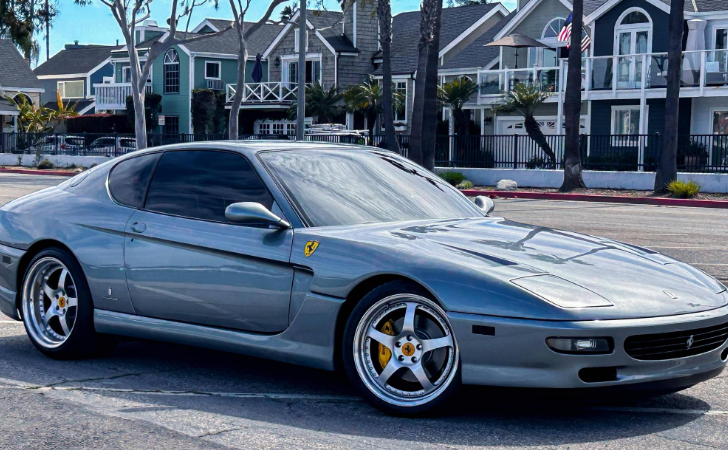
Designed by Lorenzo Ramaciotti at Pininfarina, the body of the Ferrari 456 GT was crafted almost entirely from aluminum, bonded to a rigid tubular steel chassis using a specialized sandwich material called Feran.
+——————————————————————-+
| FERRARI 456 GT DESIGN SPECIFICATIONS |
+————————–+—————————————-+
| Body Construction | Aluminum panels bonded to steel frame |
| Designer | Lorenzo Ramaciotti (Pininfarina) |
| Wheelbase | 2,600 mm (100 mm shorter than 412i) |
| Layout | Front-mid engine, rear-wheel drive |
| Drag Efficiency | Integrated underbody venturi channels |
+————————–+—————————————-+
What strikes me most after decades of analyzing supercar architecture is how utterly clean the 456 remains. In today’s market, exotics are littered with aggressive air scoops, oversized diffusers, and dramatic wing profiles needed to manage extreme downforce. The 456 GT belongs to a golden era when aerodynamic efficiency was handled quietly beneath the skin.
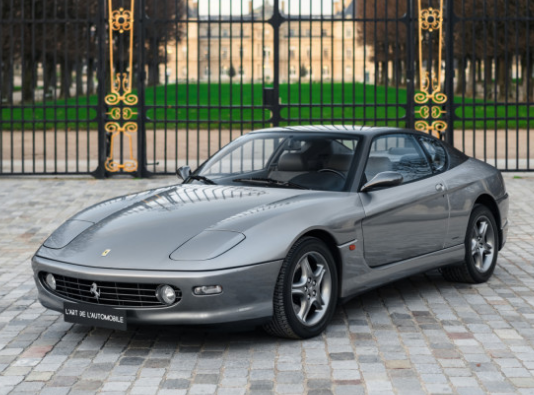
Its low, sweeping nose features classic pop-up headlights that flow effortlessly into a gracefully arched cabin. The rear features subtle quad tail lamps, four exhaust tips, and an understated pop-down rear spoiler integrated into the lower apron that deploys automatically at speed to increase stability. The 17-inch alloy wheels may look compact by contemporary standards, but the stance is pure classical sculpture. There simply isn’t a bad angle on this car.
Engineering Brilliance: The F116B Engine and Transaxle Architecture
Under that sleek aluminum bonnet lies the heart of this grand tourer: the all-new 5.5-liter atmospheric V12 engine, designated the F116B.
For tech enthusiasts and exotic car mechanics, this powerplant marked a significant evolutionary shift. Previous Maranello V12s utilized a 60-degree bank angle; for the 456, engineers widened the V-angle to 65 degrees to keep the hood line ultra-low and improve lower engine packaging.
Key Engine Features & Mechanical Highlights:
Displacement: 5,474 cc (436 hp @ 6,250 RPM / 406 lb-ft of torque @ 4,500 RPM)
Architecture: Light-alloy block, cylinder heads, and sump; 4 valves per cylinder; quad overhead camshafts.
Lubrication: Dry-sump system designed to prevent oil starvation during high-G cornering.
Drivetrain Layout: Rear-mounted 6-speed manual transaxle paired with a mechanical limited-slip differential for an ideal 50:50 weight distribution.
Top Speed: 192 mph (309 km/h), making it the second fastest four-seat production car in the world at its launch.
[ Front-Mounted 5.5L V12 Engine ]
|
(Propeller Shaft Tunnel)
|
[ Rear Transaxle: 6-Speed Manual / LSD ]
Beyond raw horsepower, the engine brought back Ferrari’s traditional naming convention where the model designation reflected the exact swept volume of a single cylinder ($5,474 \text{ cc} / 12 = 456.16 \text{ cc}$).
The chassis was equally advanced for its period. Featuring double wishbones all around and a tri-mode adjustable Bilstein damping system (Soft, Medium, Hard) that monitored road speed, steering angle, and chassis pitch, it delivered a sublime balance of long-distance compliance and high-speed stability.
The Driving Experience: Pure Analog Royalty
Opening the wide driver’s door reveals a cabin wrapped in supple Connolly leather, exuding the distinct aroma of old-world Italian craftsmanship. Sitting in the driver’s seat, you are immediately confronted by classical Ferrari ergonomics. The three-spoke leather wheel rests close to your chest, the secondary gauges (oil pressure, water temperature, fuel level) tilt gracefully toward the center console, and right beside your hip sits the legendary metal open-gate shifter.
In a world filled with lighting-quick dual-clutch transmissions, paddle shifters, and synthetic engine notes pumped through audio speakers, rowing through a gated manual transmission is a deeply physical, soul-stirring ritual.
[1] [3] [5]
| | |
–+—-+—-+–
| | |
[2] [4] [6] [R]
Turning the Key
Turn the mechanical key, and the 5.5-liter V12 fires to life instantly via its dual Bosch Motronic ECUs. There are no dramatic exhaust valve crackles or high-rev flair tricks—just a quiet, mechanical whir that settles into a velvety, muscular idle.
As you pull away, the car seemingly shrinks around you. On winding back roads, the steering feels surprisingly fast and tactile, guiding the long nose with incredible precision. The long-travel pedal layout invites rev-matched heel-toe downshifts, and once the transaxle fluid warms up, sliding that aluminum wand through the gated steel channels with a satisfying click-clack provides an intoxicating tactile feedback that modern supercars simply cannot replicate.
The engine’s torque curve is massive. From as low as 1,500 RPM in 5th gear, the V12 pulls smoothly without a hint of hesitation, building into a glorious, metallic wail as you sweep toward the 7,250 RPM redline. It doesn’t just go fast; it covers distance with an effortless, leg-stretching stride that defines the classic Grand Touring philosophy.
Evolution: 456 GT vs. 456M GT
During its 11-year production run (1992–2003), Maranello produced roughly 3,289 units of the 456 series across two primary iterations. Knowing the differences is vital if you are weighing auto auto loans, classic car investments, or garage space.
| Feature / Aspect | Ferrari 456 GT / GTA (1992–1997) | Ferrari 456M GT / GTA (1998–2003) |
|---|---|---|
| Model Designation | Early / Phase 1 | “Modificato” (Phase 2) |
| Engine Hood | Composite aluminum with retractable air vents | Carbon fiber with smoother fixed cooling design |
| Grille & Bumper | Deep, aggressive intake with fog lamps | Smoother, wider grille with integrated fog lights |
| Interior Layout | Classic five-gauge dash cluster, pop-up stereo door | Revised dashboard, modern HVAC dials, superior cup/storage layout |
| Body Production | Outsourced to Pininfarina | Brought fully in-house to Maranello |
| Firing Order | Standard F116B firing sequence | Revised firing order (F116C) for smoother idle and emissions |
| Traction Control | Primitive ABS-linked engine retard | Updated ASR stability management system |
The automatic versions—designated GTA—utilize a 4-speed torque-converter automatic sourced from GM/Ricardo. While smooth for luxury cruising, the 6-speed manual GT and 456M GT remain the absolute gold standard for collectors seeking mechanical engagement and long-term appreciation.
Real-World Ownership, Maintenance Costs, and Buyer’s Guide
Let’s address the elephant in the room: maintaining a vintage V12 Ferrari. While buying into a Ferrari 456 GT can feel like the exotic car deal of the century, maintenance neglect will turn a bargain purchase into financial ruin faster than a bad trade on Wall Street.
I always tell my clients: There is no such thing as a cheap V12 Ferrari. You either pay upfront for a well-sorted car, or you pay the mechanic later.
+—————————————————————–+
| CRITICAL PRE-PURCHASE INSPECTION Checklist |
+—————————————————————–+
| [ ] Timing Belts & Tensioners (Mandatory replacement every 3-5 yrs)|
| [ ] Window Seals & Regulator Geometry (Famous for wind noise) |
| [ ] Pop-Up Headlight Motors & Actuator Arms |
| [ ] Bilstein Actuator Tops (Self-leveling shock system leaks) |
| [ ] Radiator Core & Heater Matrix (Check for coolant leaks) |
| [ ] Valve Guide Wear (Listen for excessive blue smoke on start) |
+—————————————————————–+
Key Ownership Realities & Common Pitfalls
Cam Belt Services: The F116 V12 is an interference engine that requires new timing belts every 3 to 5 years. Luckily, unlike the mid-engined Testarossa or 348, the belt service on a 456 can be performed engine-in, significantly reducing labor costs compared to full engine-out operations.
Fragile Window Seals: The 456 features frameless door glass that automatically drops a fraction of an inch when opening the door. The rubber seals perish over time, leading to wind noise and water ingress. Fresh OEM seals can cost several thousand dollars for parts alone.
Radiators and Heater Core: Original radiators are prone to stress cracking. Modern alloy replacements are strongly recommended to protect the high-value engine block from overheating damage.
Suspension Actuators: The adjustable Bilstein shock absorbers use plastic drive gears inside the top actuators that crack over time. Metal aftermarket replacement gears are a popular, cost-effective fix.
Market Dynamics: Current Values, Valuation Trends, and Collector Outlook
From an asset-class perspective, the 456 sits in a fascinating position within classic car appraisal circles.
While two-seater V12s like the 550 Maranello and 575M have exploded into $200,000+ territory, the 456 GT has lagged behind due to its four-seat GT layout. However, smart money is noticing the gap.
ESTIMATED MARKET VALUE TREND (6-Speed Manual GT / 456M GT)
$100k +——————————————————- [Concours Condition]
| /
$80k +————————————— [Excellent] –+
| /
$60k +——————– [Good / Driver] –+
| /
$40k +– [Fair / Risk] –+
+——————+——————-+—————+
2018-2021 2022-2024 2025-2026
Entry-Level / High-Mileage (Fair): $40,000 – $55,000 (Proceed with extreme caution; require thorough service history check)
Well-Maintained Driver (Good/Very Good): $65,000 – $85,000
Pristine / Low-Mileage / Rare Spec (Concours): $95,000 – $130,000+
Manual vs. Automatic Premium: Expect to pay a $20,000 to $30,000 premium for a factory 6-speed manual over a 4-speed GTA automatic.
With exotic car financing options readily available, specialty insurance coverage expanding, and high-CPC luxury automotive loans opening access to young collectors, the 456 GT offers unprecedented value per cylinder. It is one of the last true analog V12 manual Ferraris ever built.
The Verdict: Why You Should Buy One Today
The Ferrari 456 GT represents a bygone era of pure motoring. It was created at a time when Ferrari priority wasn’t track lap times or digital screens, but crafting an effortlessly fast, profoundly comfortable, and astonishingly beautiful machine that could cross continents at 180 mph.
It has space in the rear for children or luggage, a timeless Pininfarina silhouette, a smooth gated 6-speed manual transmission, and an atmospheric 5.5-liter V12 engine that delivers endless mechanical drama.
If you have ever dreamed of owning a true V12 Maranello thoroughbred without paying astronomical modern supercar prices, the time to act is now. Find a documented car with a rich service file, get a independent pre-purchase inspection from a certified technician, and experience one of the greatest grand tourers ever made.
Ready to Find Your Dream V12 Grand Tourer?
Whether you’re looking for expert advice on sourcing a pristine manual Ferrari 456 GT, navigating exotic car loans and specialized collector insurance, or arranging a professional pre-purchase inspection with top Italian automotive specialists, we are here to guide your journey. Connect with our team of exotic car specialists today to start curating your ultimate automotive collection!