
The End of an Era: The Final Mistral and the Historic Legacy of the Bugatti W-16 Engine
As an automotive industry analyst and hypercar specialist with over a decade of hands-on experience evaluating the world’s most exclusive vehicles, I have witnessed countless powertrain trends come and go. We have seen the rise of hybridization, the push for full electrification, and the downsizing of displacement across nearly every automotive sector. Yet, through all the shifting tides of the global market, one mechanical masterpiece has stood unbothered at the absolute pinnacle of automotive engineering: the Bugatti W-16 engine. Today, the hypercar landscape stands at a monumental crossroads. The era of the Bugatti W-16 engine is officially drawing to a close, marked by the completion of the final Bugatti Mistral at the legendary Molsheim production facility.
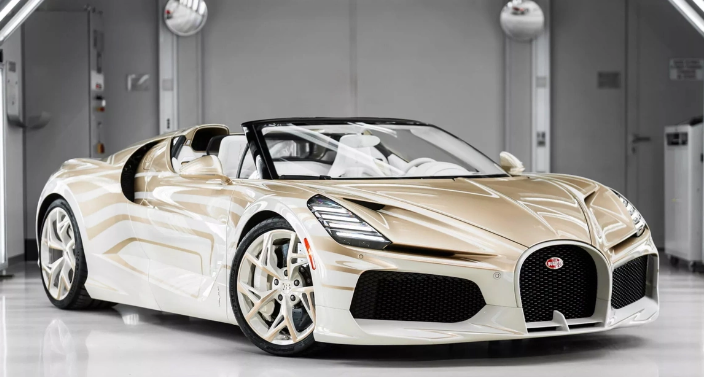
This final iteration of the Mistral, aptly and poignantly named “The last of its kind,” represents much more than just another limited-run bespoke build. Bearing the chassis number 99, this vehicle is the ultimate open-roof variant of the Chiron platform. Considering Bugatti manufactured exactly 500 Chirons over its production cycle, this specific run of 99 Mistrals makes it exceptionally rare. But rarity is only a fraction of the story. The beating heart of this machine is the final road-going application of the legendary Bugatti W-16 engine. For collectors, enthusiasts, and automotive historians, this represents the definitive conclusion of a two-decade reign where the quad-turbo supercar rewrote the laws of physics.
To truly understand the gravity of this moment, we must examine what the Bugatti W-16 engine actually achieved. When it was first introduced, the automotive world was stunned by its sheer audacity. Merging two narrow-angle V8 engines into a single W configuration and strapping four turbochargers to it was a feat of thermodynamic and aerodynamic engineering that many deemed impossible for a reliable street-legal car. Managing the heat rejection alone required a cooling system that rivaled commercial aircraft. Over the years, the Bugatti W-16 engine evolved, pushing power outputs from an initial 1,000 horsepower to a staggering 1,578 horsepower in its final, most highly tuned iterations. This relentless pursuit of power is what allowed the Mistral to claim the title of the world’s fastest open-roof production vehicle. Hitting a verified 282 mph at the Papenburg testing facility in 2024, the Mistral proved that the Bugatti W-16 engine remained the undisputed king of top-speed supremacy right up until its retirement.
From a financial and market-valuation perspective, the cessation of the Bugatti W-16 engine production fundamentally shifts the landscape of investment grade supercars. Over the past ten years, I have advised numerous clients on high net worth vehicle investments, and the data is unequivocal: analog, highly bespoke, internal combustion masterpieces are rapidly transitioning into highly liquid wealth management assets. As the Bugatti W-16 engine enters the history books, the existing supply is permanently capped. We are already seeing aggressive movement in the secondary market. When specialized luxury auto dealers in Los Angeles or brokers handling hypercars for sale in Miami acquire a W-16 powered vehicle, the premiums commanded are staggering.
The financial infrastructure surrounding these vehicles is equally complex and fascinating. Acquiring a final-run Mistral is not merely a cash transaction; it involves specialized luxury auto financing structures designed specifically for ultra-high-net-worth portfolios. Because these vehicles historically appreciate rather than suffer from standard luxury vehicle depreciation, financial institutions treat them akin to blue-chip art. Furthermore, the underwriting process for exotic car insurance on a multi-million-dollar, 282-mph open-roof hypercar requires bespoke actuarial models. Protecting a vehicle powered by the irreplaceable Bugatti W-16 engine involves comprehensive global policies, covering everything from static display risks to the highly specialized exotic car transport required to move the vehicle safely between international residences or prestigious concours events.
Visually and tactilely, Bugatti ensured that the final vehicle to house the Bugatti W-16 engine was nothing short of a bespoke masterpiece. Bugatti officially describes this ultimate Mistral as the closing chapter to the road-going story of the W-16. To commemorate this milestone, the brand’s designers executed a flawless two-tone Pearl and Sparkle exterior finish. While the subtle interplay between the two pristine shades demands direct sunlight to truly appreciate, it exudes a quiet confidence—a stark contrast to the violent capability of the Bugatti W-16 engine resting behind the cabin.
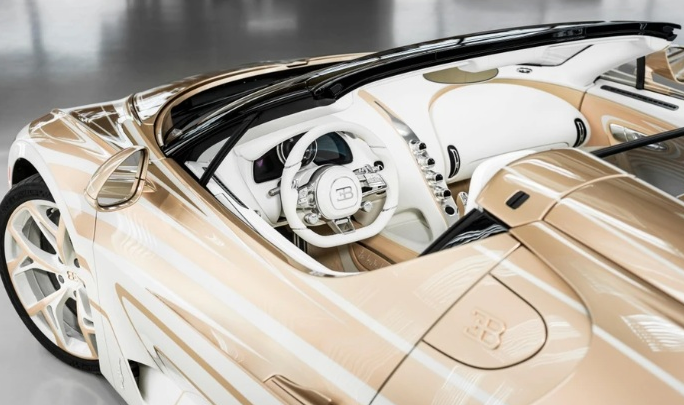
Stepping into the cabin reveals a masterclass in bespoke luxury cars. The interior is meticulously appointed in a dual-tone Magnolia and Grey Carbon Matt configuration, blending traditional, hand-stitched organic luxury with modern, aerospace-grade lightweight composites. Everywhere you look, there are distinct homages to the brand’s heritage. Ettore Bugatti’s iconic signature is permanently etched into the headrests, the precision-milled aluminum door sills, and directly onto the engine cover shielding the final Bugatti W-16 engine.
Perhaps the most breathtaking detail in this final Mistral is the frozen crystal glass plate seamlessly integrated into the center armrest. Inscribed with the words “Spirit of the Wind,” this element pays tribute to the aerodynamic focus of the open-roof production vehicle while celebrating Bugatti’s historic, long-standing collaborative relationship with the renowned French glassmaker, Lalique. It is a subtle, elegant touch that grounds the earth-shattering performance of the Bugatti W-16 engine in classic French artistry. While it may not be as visually disruptive as the porcelain-infused Blanc Eternal Bugatti unveiled earlier in the season, this specific Mistral carries an emotional weight that no amount of porcelain could replicate. It is the definitive period at the end of a breathtaking sentence.
So, what happens now that the Bugatti W-16 engine has completed its road-going duty? The luxury hypercar sector abhors a vacuum, and Bugatti is entirely prepared for the next automotive epoch. Moving forward, the brand is boldly shifting away from forced induction, replacing the quad-turbo Bugatti W-16 engine with a highly advanced, naturally-aspirated V-16 powertrain. Displacing a massive 8.3 liters, this new naturally-aspirated V-16 is designed to deliver a dramatically different, higher-revving, and more visceral auditory experience.
This next-generation powerplant will make its highly anticipated debut in the all-new Bugatti Tourbillon. The transition from the Bugatti W-16 engine to the V-16 Tourbillon is not just a change in mechanics; it represents a comprehensive evolution of the brand’s manufacturing philosophy. Just days before this final Mistral rolled off the line, Bugatti officially inaugurated “La Manufacture,” a state-of-the-art facility in Molsheim dedicated exclusively to housing the production of the V-16 and the future Tourbillon.
While Bugatti’s meticulously worded press releases state that the Mistral marks the end of the Bugatti W-16 engine’s “road-going story,” industry insiders and seasoned analysts note the specific phrasing. This carefully crafted language leaves a narrow window open for the Bugatti W-16 engine to potentially return in a track-only, non-homologated capacity—perhaps an ultimate hyper-track weapon unburdened by global emissions or pedestrian safety regulations. However, from the standpoint of production street-legal vehicles that you can drive down the coast or display on the lawn at Pebble Beach, the Bugatti W-16 engine has officially concluded its legendary run.
The legacy of the Bugatti W-16 engine will be studied by automotive engineers and market analysts for generations. It arrived in an era when 1,000 horsepower seemed like science fiction, and it departs having normalized hypercar performance metrics that dwarf early Formula 1 cars. It proved that extreme speed, unparalleled bespoke luxury, and daily-drivable reliability could coexist in a single, magnificent package. For those who were fortunate enough to experience the relentless, turbine-like thrust of the Bugatti W-16 engine, the memories are permanent. The final Mistral is a beautiful, brutal, and fitting farewell to a powertrain that defined the absolute ceiling of modern internal combustion.
As we close the book on the W-16 and look toward the naturally-aspirated future of the Tourbillon, the hypercar market is experiencing an unprecedented period of transition and opportunity. Whether you are actively managing a portfolio of investment grade supercars or simply looking to acquire a piece of definitive automotive history before the market entirely shifts, there has never been a more critical time to evaluate your next acquisition. If you are ready to explore specialized luxury auto financing, secure comprehensive exotic car insurance, or locate an off-market hypercar masterpiece tailored to your specific collection, I invite you to reach out directly to discuss how we can strategically position your garage for the future of luxury mobility.