
Driven: How the Porsche 718-Based Stärke Speedster Redefines Vintage Romance for the Modern Era
If you spend enough time around the Southern California Porsche culture, you start to notice a distinct dividing line. On one side of the paddock, you have the purists—the folks who will measure the panel gaps on an air-cooled classic and argue over period-correct hose clamps. On the other side, you have the modernists who demand daily-driver reliability, blistering track times, and an air conditioning system that actually combats the midday Los Angeles heat. Bridging that canyon has always been the holy grail of exotic car customization.
Enter the Stärke Speedster.
When boutique custom coachbuilder Stärke Motor Company rolled out its second-generation prototype at the recent Air|Water gathering in Southern California, it immediately challenged our preconceived notions of what a heritage-inspired build should be. This isn’t a fragile, six-figure restoration of a classic tub, nor is it a traditional restomod where a builder attempts to shoehorn a modern powertrain into a fifty-year-old monocoque chassis. Instead, the Stärke Speedster takes the opposite, arguably smarter approach: it drapes the romantic, sweeping lines of motorsport’s golden era over the brilliant, mid-engine backbone of the modern Porsche 718 Boxster platform.
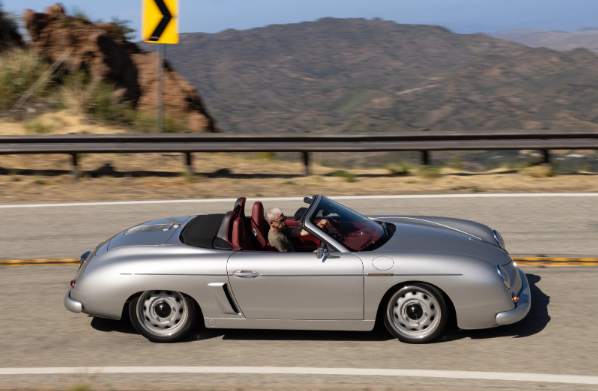
After the crowds dispersed from the show, I met up with Stärke CEO Seth Gortenburg for a proper shakedown. We pointed the car toward the Pacific Coast Highway in Malibu—the ultimate proving ground for bespoke sports cars—to find out if this ambitious project is just a pretty face, or if it legitimately earns its place in the modern automotive landscape.
The Philosophy of the Custom Coachbuilder
To understand the Stärke Speedster, you have to understand the mind behind it. Seth Gortenburg cut his teeth in the American hot-rodding scene, a world where custom fabrication and mechanical problem-solving are paramount. That background deeply informs the ethos of his company.
In the high-stakes world of luxury custom car builder services, the temptation is always to start with a classic car and try to “fix” its inherent flaws. But anyone who has driven a vintage 356 or an early 550 Spyder knows the reality. They are undeniably beautiful and deeply historic, but they lack horsepower, their suspension geometries are archaic, and living with one on a daily basis means dealing with constant valve adjustments, finicky carburetors, and the inevitable oil spots on your garage floor.
Gortenburg asked a fundamentally different question: Why compromise on modern driving dynamics just to get a classic aesthetic?
By utilizing a late-model donor, the Stärke Speedster effectively bypasses the headaches of vintage ownership. You get the power-folding top, the side windows, the modern crash safety structures, and the perfectly calibrated HVAC system of a 21st-century vehicle, all wrapped in a body that looks like it just rolled out of a paddock in the late 1950s. It’s a compelling value proposition in the premium auto restoration services market, especially for buyers who want the quintessential James Dean aesthetic without the roadside breakdowns.
Sculpting the Illusion: Design and Engineering
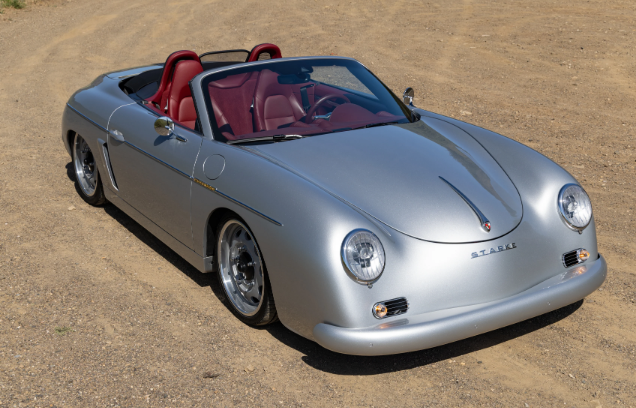
From a hundred feet away, the Stärke Speedster plays tricks on your eyes. It clearly pulls inspiration from Stuttgart’s earliest and most revered models. You can see echoes of the mid-engined 550 Spyder, the legendary 718 RSK, and the iconic rear-engined “bathtub” 356 Cabriolet. But as you get closer, the proportions shift. It is undeniably wider, longer, and lower than any of those mid-century icons.
Photographs genuinely struggle to convey the sheer presence of this car. It occupies a much larger footprint, which gives it an aggressive, planted stance that the originals simply didn’t possess.
Achieving this look on a modern chassis is an engineering marathon. Transitioning from Stärke’s original 981-based projects to the current 718 architecture required comprehensive 3D scanning and sophisticated CAD rendering. It took the team two solid years to perfect the hand-laid body panels.
The build process is radical. Transforming a factory vehicle into a Stärke Speedster involves stripping the donor car down to its core architecture. The factory doors and rear exterior panels are cut away. The new bespoke front clip is meticulously engineered to mount directly to the factory bolting locations, ensuring structural integrity isn’t compromised. At the rear, the inner fenders are chemically bonded to the new quarter-panels to provide immense rigidity, while custom side strakes are integrated to feed air into the Boxster’s original factory intakes.
Even the wheels are a masterful piece of deception. Gortenburg conceptualized a one-off set he calls the “Wide Five.” Cast to accommodate modern performance tires and big brakes, they expertly mimic the look of original Porsche steelies.
When evaluating luxury bespoke sports cars, build quality is the metric that separates the hobbyists from the professionals. Gortenburg’s hot-rod roots shine through here. The metallic silver paint on our test car exhibited miles of depth, totally devoid of orange peel. The panel gaps were laser-straight from nose to tail. And, crucially, the entire package felt cohesive.
Driving the Pacific Coast Highway
Climbing into the cockpit is a familiar experience, as the interior architecture remains distinctly modern Porsche. You twist the key on the left side of the steering column, and the engine fires up with modern fuel-injected immediacy.
Our test mule for the day was based on a base-model 718 equipped with the 2.0-liter turbocharged flat-four and the lightning-fast seven-speed PDK dual-clutch transmission. While purists often clamor for the naturally aspirated wail of a flat-six, starting with the base turbo-four for the prototype was a calculated move. Gortenburg wanted to use the entry-level powertrain to identify and iron out any chassis or NVH (noise, vibration, and harshness) issues before moving on to higher-horsepower customer commissions.
Rolling onto the Pacific Coast Highway in Malibu, the most striking realization was what I didn’t feel. There were no mysterious clunks over expansion joints. There was no cowl shake. There were zero squeaks or rattles from the custom bodywork. Aside from the standard wind noise you’d expect from a factory convertible top, the cabin was serene.
Because the standard fiberglass body panels weigh roughly the same as the factory steel and aluminum pieces they replace, the Stärke Speedster retains the impeccable, world-class driving dynamics of the 718. It still feels like one of the most perfectly balanced mid-engine sports cars ever engineered. The steering turn-in is telepathic. The suspension effortlessly straddles that razor-thin line between canyon-carving stiffness and grand-touring compliance.
“That’s one of the beauties about what we’re doing,” Gortenburg shouted over the wind noise from the passenger seat. “A 356 is beautiful, but there’s not a lot of horsepower there, and they didn’t handle that great. These cars can handle. They are made to drive hard.”
And drive hard we did. Pushing the car through tight Malibu canyon sweepers, the low center of gravity and wider track provided immense confidence. It cornered flat, the PDK snapping off downshifts with ruthless efficiency before corner entry. It is an incredibly weird, wonderful cognitive dissonance to look out over those vintage, sweeping front fenders while experiencing the G-forces of a modern chassis.
I did have one minor critique regarding the daily drivability. The extended front overhang and aggressively low ride height make traversing steep driveways, typical Los Angeles speed bumps, and uneven turnouts a bit of a nail-biting experience. A front-axle lift system feels like a mandatory addition here, especially if a buyer opts for Stärke’s premium carbon fiber body upgrade.
Speaking of carbon fiber, checking that option box sheds a couple of hundred pounds from the curb weight. Considering a standard 718 weighs around 3,000 pounds, shaving that much unsprung and sprung mass elevates the acceleration and braking performance noticeably, making the upgrade highly recommended for those looking for the ultimate edge in exotic car customization.
The High-End Automotive Investment Equation
As the automotive industry marches inevitably toward electrification, analog and internal combustion sports cars are experiencing a massive shift in market perception. The 718 generation officially ended its production run late last year, with Porsche pivoting toward an EV future for its mid-engine platform. As a result, we are already seeing the residual values of ICE (internal combustion engine) 718s bolting upward on the secondary market.
This makes commissioning a Stärke Speedster an interesting proposition in the realm of Porsche investment cars.
Pricing for the conversion starts at $135,000. If you prefer a turnkey solution where Stärke sources the donor vehicle for you, expect to start around $189,000 before you dive into personalized options.
The math works out like this: A clean, low-mileage base 718 with a PDK can currently be sourced in the neighborhood of $40,000. However, Stärke can adapt this body to any 718. You could opt for the 350-horsepower Boxster S, or go straight to the top of the food chain with the 394-horsepower GTS 4.0, which boasts that glorious 7,800-rpm naturally aspirated flat-six. Sourcing a pristine GTS 4.0 with a six-speed manual gearbox will easily push the donor car cost past the six-figure mark.
The remainder of the financial outlay goes toward amortizing the massive design and development costs, the 12 weeks of proprietary panel crafting, and the hundreds of hours of labor required to execute the body swap to Stuttgart standards. It’s a serious investment, but in the stratosphere of custom luxury auto restoration—where outfits like Singer or Gunther Werks charge well over a million dollars and demand multi-year waits—the Stärke Speedster feels remarkably accessible for the level of presence it commands.
Currently, the waiting list hovers around one year, with actual build time taking about six months once your car enters the bay. For those who want the process to move as efficiently as possible, Stärke advises finalizing your interior spec first, so upholstery and trim finishing can happen concurrently with the exterior teardown.
If I were writing the check tomorrow, I would pair the 4.0-liter GTS engine with a manual transmission to fully lean into the mechanical romance of the aesthetic. Visually, the classic metallic silver over a Boxster Red interior is flawless, though a deep, non-metallic black over a custom Pepita houndstooth cabin would give the car a menacing, tailored-suit elegance. Furthermore, Gortenburg hinted that a Cayman-based coupe version is in the development pipeline for those who prefer a fixed-roof aesthetic.
The Best of Both Worlds
Porsche purists will always exist, and there will always be a vocal minority who view altering a factory chassis as automotive heresy. But the restomod and custom coachbuilding industry isn’t building cars for the purists; they are building cars for enthusiasts who want to drive their art without compromises.
By refusing to cut up increasingly rare, historically significant air-cooled chassis, Stärke respects the heritage of the brand while offering a superior driving product. They have successfully distilled the essence of a bygone era and injected it with the reliability, comfort, and safety that modern drivers demand. The Stärke Speedster is a masterclass in exotic car customization, proving that you really can have the vintage romance without the vintage headaches.
Are you ready to stop compromising between classic aesthetics and modern performance? Whether you are looking to source a donor 718 or want to start designing your bespoke build from the ground up, now is the time to secure your allocation before the waiting list grows even longer. Reach out to the team at Stärke Motor Company today to explore your custom coachbuilding options and take the first step toward building the ultimate modern classic.