
2026 Toyota Land Cruiser Commercial Review: The Ultimate Off-Road Cargo Rig Built for Tax Efficiency
Travel to the most unforgiving, rugged corners of the globe, and you will quickly realize one universal truth: the Toyota Land Cruiser remains the undisputed king of the wilderness. From the scorching expanse of the Sahara Desert to the brutal isolation of the Australian Outback, its reputation for unbreakable strength and legendary reliability has cemented its status as the go-to vehicle in regions where a mechanical failure isn’t just an inconvenience—it is a matter of survival. This point was driven home on a recent expedition to Morocco, where dozens of trail-hardened Land Cruisers across multiple generations dominated the landscape.
However, amidst this lineage of passenger-hauling survival vehicles lies a fascinating, highly specialized offshoot: the 2026 Toyota Land Cruiser Commercial. This unique J250-generation off-road cargo van ditches its second and third-row seats in favor of a cavernous, flat load area. Even more intriguing is its manufacturing journey. The Toyota Land Cruiser Commercial does not roll off the primary assembly lines in Japan in this configuration. Instead, it arrives in the United Kingdom as a standard passenger SUV before undergoing a rigorous cargo conversion at Toyota’s Derbyshire facility—the exact same manufacturing hub responsible for producing the U.S.-bound GR Corolla. Currently, the Toyota Land Cruiser Commercial is sold exclusively in the U.K., the Republic of Ireland, and a select few European markets that offer aggressive financial incentives for commercial van conversions.
The Financial Engine Driving the J250 Cargo Van
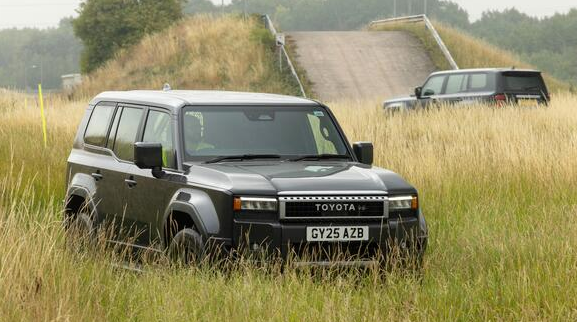
To understand the existence of the Toyota Land Cruiser Commercial, you have to look past the suspension articulation and dive into the tax code. While this 4×4 commercial vehicle can indeed haul bulkier, more awkwardly shaped payloads than its standard SUV counterpart, the primary motivation behind its engineering is aggressively cutting tax bills.
In the U.K. and several other European nations, the tax framework heavily favors vehicles classified as commercial vans. Drivers who operate vans for work purposes are subjected to drastically lower taxation for “private” use compared to conventional passenger cars. Furthermore, the upfront purchase taxes on these commercial conversions are significantly reduced. In practical terms, purchasing the Toyota Land Cruiser Commercial subjects the buyer to a nominal Vehicle Excise Duty (VED) charge of just £345 (roughly $460 USD at current exchange rates). If that same buyer opted for the standard passenger Land Cruiser, they would be hit with a punishing £5,490 ($7,340 USD) VED bill.
This massive discrepancy has birthed a highly lucrative niche of SUV-to-van conversions. Competitors like the Land Rover Defender Hard Top and the Ineos Grenadier Commercial have also entered this space, targeting businesses that require off-road fleet trucks. For enterprise buyers, these commercial vehicle tax incentives completely change the total cost of ownership. When fleet managers run the numbers on business auto tax deductions and secure favorable fleet vehicle financing, the return on investment for a heavy-duty 4×4 van becomes undeniable. Even commercial auto insurance rates for standardized fleet vans can occasionally offer bulk advantages, making the Toyota Land Cruiser Commercial a shockingly pragmatic choice for agricultural businesses, utility companies, and remote survey teams.
Engineering a Workhorse: Interior and Design Anomalies
Approaching the Toyota Land Cruiser Commercial, it is immediately apparent that this rig was not originally conceived as a dedicated cargo truck. The exterior profile retains the rear door glass, but these windows are permanently fixed. Heavy-duty interior hard covers are bolted directly behind the glass to protect it from shifting pallets, loose tools, or heavy equipment.
Inside the rear side doors, the window motors remain physically installed in the door panels, but the company has fitted permanent blanking plates over the switches to disable them. The rear window controls on the driver’s master switch panel are similarly blanked out with factory-grade plastic inserts. In the rear compartment, all passenger grab handles and seatbelt assemblies have been completely stripped. Yet, in a quirky nod to its passenger-car origins, the Toyota Land Cruiser Commercial retains the third-row cupholders molded into the rear side plastic trim.
Toyota is also acutely aware that some opportunistic buyers might attempt to purchase the Toyota Land Cruiser Commercial purely for the commercial vehicle tax incentives, only to illegally reinstall rear seats later. To prevent this, the factory permanently cuts away the structural mounting points for the rear seats, burying the modified chassis floor beneath a heavy-duty, flat cargo deck. A heavy-gauge, full-height steel mesh bulkhead is bolted behind the front seats to protect the driver and passenger from flying cargo during sudden deceleration, while multiple reinforced lashing points are integrated into the floor to secure heavy loads.
Because the Toyota Land Cruiser Commercial is based on the high-specification European-market Land Cruiser, the cabin is an anomaly of rugged utility and premium luxury. It still features a power-operated rear tailgate with a separately opening upper glass hatch. However, because the standard trunk floor is gone, replaced by a much lower cargo deck, the separate glass hatch is practically useless—anything dropped through it will plummet straight to the commercial floor. Up front, operators are treated to power-adjustable, heated, and ventilated seats, a high-end audio system, and advanced radar cruise control. It is, without question, one of the most luxurious two-seat vans on the global market.
Powertrain: The 2.8-Liter Turbodiesel Advantage
Driving a European-spec Land Cruiser provides a rare opportunity to test a forbidden-fruit powertrain entirely absent from the North American market. Under the hood of the Toyota Land Cruiser Commercial sits a robust 2.8-liter turbocharged inline-four diesel engine, lightly assisted by a 48-volt mild-hybrid system. This specific engine configuration remains the most heavily demanded option for drivers venturing deep into extreme environments, prioritizing low-end grunt and mechanical resilience over high-horsepower sprints.
The diesel powerplant produces 202 horsepower and a substantial 369 lb-ft of torque. On paper, these figures might seem slightly underwhelming against the Toyota Land Cruiser Commercial’s hefty 5,200-pound unladen curb weight. However, peak torque is delivered at a remarkably low 1,600 rpm. Paired with an incredibly intuitive and well-calibrated eight-speed automatic transmission, the cargo van rarely feels sluggish in real-world applications.
That said, this gruff diesel is not the most refined companion, particularly when benchmarked against the remarkably smooth 3.0-liter inline-six diesels available in the European variants of the Defender and the Grenadier. The Toyota Land Cruiser Commercial exhibits noticeable vibration at idle and a vocal, clattery roar under heavy throttle. It also shares a typical diesel aversion to high revs. When left in standard automatic drive mode, the transmission aggressively short-shifts, refusing to push past 3,800 rpm even with the accelerator pinned to the floorboards. Reaching the digital tachometer’s marked 4,400-rpm redline requires switching the gearbox into full manual mode and forcing the issue.
Driving Dynamics: Highway Cruising to Off-Road Hauling
Once the Toyota Land Cruiser Commercial reaches highway cruising speeds, the mechanical clatter subsides, and refinement becomes highly acceptable—easily surpassing the NVH (noise, vibration, and harshness) levels of a standard steel panel van like a Ford Transit. Toyota claims a 10.2-second sprint from zero to 62 mph, a performance metric that absolutely zero commercial buyers will ever care to test. Hard acceleration causes the vehicle to visibly squat on its rear suspension, adopting a distinct nose-up posture. High-speed pursuit is clearly not its forte; the steering requires constant micro-corrections to maintain lane discipline on its Dunlop AT23 Grandtrek tires, and the windshield wipers begin to lift and struggle at speeds exceeding 75 mph.
Like most heavy-duty trucks, the suspension of the Toyota Land Cruiser Commercial is explicitly tuned to carry weight. Driven entirely unladen, the rear end feels stiff and underdamped over broken pavement, translating sharp impacts and jagged terrain directly into the cabin. But the moment you introduce actual payload—such as strapping a 220-pound historic brass fire pump into the cargo bay for a specialized equipment test—the entire chassis settles. With weight over the rear axle, the Toyota tackles aggressive bumps, potholes, and highway undulations with supreme composure.
While extensive rock-crawling wasn’t on the itinerary, the Toyota Land Cruiser Commercial effortlessly conquered miles of deep, sunbaked ruts and dried-out mud tracks. It sacrifices absolutely zero off-road capability compared to the passenger model. It retains the advanced two-speed transfer case, a driver-selectable manually locking center differential, and Toyota’s proprietary traction-management software, ensuring this commercial rig will keep moving forward long after traditional fleet vans have buried themselves to the axles in mud.
Practicality and Payload: Where it Shines and Stumbles
The most glaring weakness of the Toyota Land Cruiser Commercial is that, from a pure volume standpoint, it isn’t an inherently great van. The cargo area measures 66.4 inches in length, 50.6 inches in width, and 42.9 inches in height. While that is a massive amount of space for an SUV, the inherently high floor clearance required for off-road ground clearance makes loading heavy or awkwardly shaped pallets incredibly difficult. You are lifting cargo significantly higher than you would in a Mercedes Sprinter.
Furthermore, the massive, top-hinged power tailgate limits tight-quarters practicality. Opening the rear hatch requires substantial clearance behind the vehicle, making it much harder to use in crowded urban loading zones compared to a van with traditional 50/50 side-hinged barn doors.
However, no business is buying the Toyota Land Cruiser Commercial as a direct substitute for a city-bound delivery van. They are buying it for remote access, maximum payload, and heavy-duty towing. The reinforced cargo bed is rated to carry payloads up to 1,780 pounds, vastly outperforming a standard Land Cruiser with folded seats. Even more impressively, it boasts a maximum towing capacity of 7,700 pounds—the absolute legal maximum allowed for a vehicle of this classification under stringent European transport regulations.
The Expert Verdict
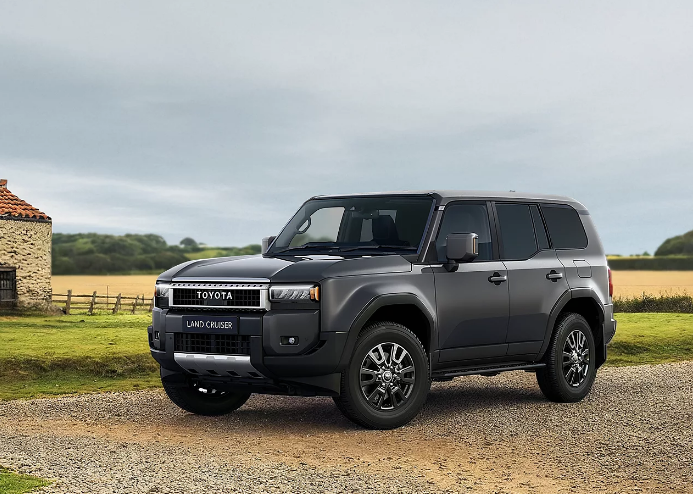
The 2026 Toyota Land Cruiser Commercial is a spectacular, oddball execution of one of the greatest 4×4 platforms ever engineered. It is a masterclass in exploiting commercial vehicle tax incentives while delivering bulletproof reliability for off-road fleet trucks. Yes, the lack of side-hinged rear doors and the high lift-over height are practical frustrations. And yes, the inability to transport more than one passenger strictly limits its use cases.
But the financial math is simply too good to ignore. Priced at £50,640 ($67,800 USD) pre-tax, it undercuts the most affordable passenger-spec Land Cruiser Invincible by a staggering £9,000 ($12,000 USD). That is a massive capital saving for an immensely capable, luxurious, and rugged workhorse that will outlast almost anything else in your commercial fleet.
If your business operations demand venturing past where the pavement ends, and you want to optimize your fleet vehicle financing while shrinking your corporate tax burden, this is the ultimate tool for the job. Reach out to your local commercial fleet specialist today to secure an allocation, or subscribe to our insider newsletter for the latest deep dives into high-performance commercial utility vehicles.