
The 2026 Nissan Leaf Nismo Review: A Masterclass in EV Chassis Tuning Over Brute Horsepower
As an automotive journalist and test driver who has spent the last ten years evaluating everything from bare-bones commuter cars to hyper-powered track monsters, I have witnessed firsthand the shifting tides of the automotive industry. We have watched electric cars evolve from glorified golf carts into zero-emission hypercars capable of bending the laws of physics. Yet, amidst the horsepower wars dominated by tri-motor behemoths, we often lose sight of what actually makes a car fun to drive. Enter the 2026 Nissan Leaf Nismo, a vehicle that merges the practical, everyday reality of electric driving with the legendary motorsport heritage of Nissan’s elite tuning division.
For over a decade, the standard Leaf has been the sensible, rational choice for eco-conscious drivers. It has served as a pioneer of the zero-emissions movement, offering solid range, extreme affordability, and practical daily utility. However, “pulse-pounding performance” was rarely included in the standard Nissan Leaf specs. The 2026 Nissan Leaf Nismo aims to shatter that conservative reputation. But before you anticipate a GT-R-slaying electric powertrain, we need to clarify what this car actually is, and more importantly, what it isn’t. In a market obsessed with face-melting straight-line speed, Nissan has taken a remarkably old-school, purist approach to making the Nissan Leaf Nismo faster around a track: they ignored the horsepower and perfected the handling.
The Philosophy: Why Chassis Dynamics Trump Raw Output
When rumors first swirled about a performance variant of the latest generation Leaf, enthusiasts immediately speculated about massive battery upgrades and dual-motor setups. The reality is far more nuanced. The 2026 Nissan Leaf Nismo does not boast any more horsepower than its standard counterpart. Depending on the trim, output remains locked at either 174 horsepower (130 kW) and 254 lb-ft of torque for the B5 variant, or a more spirited 215 horsepower (160 kW) and 262 lb-ft of torque for the top-tier B7 model. Both remain strictly front-wheel drive.
To the uninitiated, placing a Nismo badge on a car without a power bump might seem like a marketing gimmick. But any seasoned track veteran will tell you that straight-line speed is only a fraction of the performance equation. The true bottleneck in modern performance electric vehicles isn’t a lack of power; it is the sheer mass of the lithium-ion battery packs and how that weight behaves dynamically in a corner.
This is where the magic of the Nissan Leaf Nismo shines. Instead of entering an arms race that degrades efficiency, Nissan focused heavily on agility. In the realm of custom EV tuning, tweaking high-voltage electric motors can be incredibly complex and often voids critical warranties. By focusing on mechanical grip and structural rigidity, the engineering team has transformed the crossover into a canyon-carving scalpel. The Nissan Leaf Nismo is proof that you do not need 1,000 horsepower to build a highly engaging electric vehicle.
Suspension and Grip: The Mechanical Mastery
The foundation of the 2026 Nissan Leaf Nismo lies in its heavily revised chassis. Built upon the advanced Renault-Nissan-Mitsubishi Alliance AmpR Medium platform—and utilizing active liquid-cooled battery packs for superior thermal management—the crossover already possessed a stiff, capable base. Nismo engineers took this architecture and recalibrated it for the apex.
The vehicle features exclusive Nismo-tuned springs, thickened stabilizers, and selected member bushes specifically designed to dial out the understeer typically associated with front-wheel-drive EVs. The true stars of the suspension setup, however, are the swing-valve-equipped shock absorbers. Lifted directly from the technology used in the X-Trail Nismo, these advanced dampers mitigate initial body roll during aggressive turn-in while maintaining enough compliance to absorb harsh road imperfections. It provides a level of dampening sophistication that completely masks the crossover’s curb weight, which hovers around 4,187 pounds.
But a brilliantly tuned suspension is useless without the right rubber. Dropping the hard, low-rolling-resistance tires usually fitted to maximize EPA range, the Nissan Leaf Nismo is outfitted with Michelin Pilot Sport 5 tires. Finding the right performance tires for EVs is a balancing act of handling lateral loads and managing instant torque, and the Pilot Sport 5s are a spectacular choice. These sticky tires are wrapped around exclusive 19-inch Enkei aluminum wheels that are highly rigid yet remarkably lightweight, significantly reducing the unsprung mass at all four corners. The result is steering response that is immediate, communicative, and sharp—traits that are often entirely absent in the commuter EV segment.
Aerodynamics and the Nismo Aesthetic
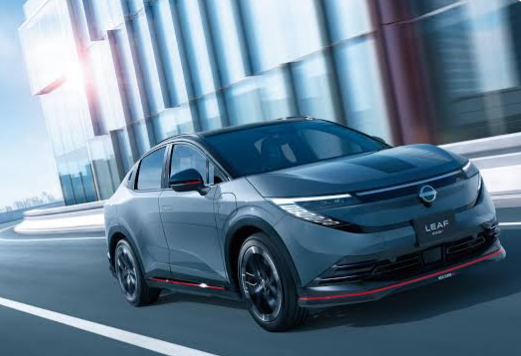
Aesthetics play a massive role in the psychological appeal of a performance car, and the Nissan Leaf Nismo looks the part. The 2026 redesign saw the Leaf transition from a traditional five-door hatchback into a sleek, aerodynamic subcompact crossover SUV. The Nismo division capitalized on this new canvas, ensuring that every aggressive line serves a functional aerodynamic purpose.
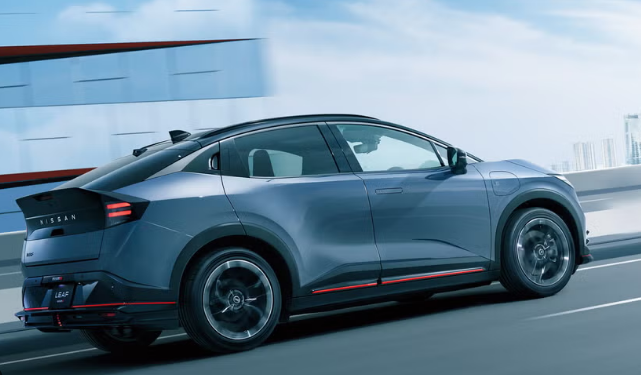
The front bumper utilizes specialized corner finishers designed to guide turbulent airflow smoothly down the sides of the vehicle. Lower-door extensions give the crossover a wider, more planted stance, visually hugging the tarmac. At the rear, you will find a boat-hull-style under-spoiler integrated seamlessly with an extended ducktail spoiler. According to Nissan’s wind tunnel testing, this bespoke aerodynamic package generates measurable downforce, improving high-speed stability without increasing the vehicle’s coefficient of drag—a vital achievement for preserving battery efficiency.
Aesthetically, the Nissan Leaf Nismo is draped in the brand’s signature “Arterial Magma” red accents, which trace the lower perimeter of the car and slash across the gloss-black side mirrors. Buyers have access to six exterior finishes, including two exclusive, brooding Nismo Stealth Gray options that look incredibly sinister under city streetlights.
Stepping into the cabin, the motorsport theme continues. The interior is a driver-focused cocoon enveloped in a dark, stealthy motif heavily contrasted by red stitching. The TailorFit synthetic-leather steering wheel features a bold red center marker—a subtle nod to its track-day aspirations. For those seeking the ultimate connection to the chassis, Nissan offers optional, Nismo-tuned Recaro sports seats with continuously adjustable electric reclining functions. These bucket seats aggressively bolster your torso, ensuring you stay firmly planted when those Michelin tires bite into a tight hairpin.
Recalibrated Software: Nismo Mode and Regenerative Braking
While the physical electric motor remains unchanged, how that motor delivers its power has been entirely rewritten. The standard Nissan Leaf specs offer Eco, Standard, and Sport drive modes. In the Nissan Leaf Nismo, that Sport setting is replaced by a dedicated “Nismo Mode.”
Unlike some modern performance EVs that try to mimic internal combustion engines through artificial noise or simulated, jerky gear shifts, the Nissan Leaf Nismo embraces its electric nature. Nismo Mode sharpens the throttle mapping to deliver what Nissan describes as “powerful, linear acceleration.” In my experience testing EV throttle maps, standard electric cars often taper off power aggressively to prevent wheel slip. Nismo Mode relaxes these electronic nannies just enough to let the front tires scramble for traction, offering a raw, unfiltered surge of electric torque that feels vastly more aggressive than the 215-horsepower figure suggests.
Furthermore, the Nissan Leaf Nismo breaks new ground for the brand by being the first electric Nismo model to feature steering-wheel-mounted regenerative braking control paddles. Drivers can instantly toggle between four levels of deceleration. Level 1 offers a free-rolling sensation ideal for highway cruising, while Levels 2 through 4 provide aggressive, immediate stopping power the moment you lift off the accelerator. This allows skilled drivers to balance the chassis mid-corner entirely with their right foot, essentially offering a highly tunable one-pedal driving experience built for the racetrack.
The Economics of Performance EV Ownership
When analyzing a specialized vehicle like the 2026 Nissan Leaf Nismo, one must look beyond the spec sheet and consider the broader economics of ownership. Transitioning to a performance-oriented electric crossover introduces new financial variables that prospective buyers must navigate.
For instance, finding the best EV auto loans or hunting down competitive electric car lease deals becomes crucial when stepping up to a premium trim. Performance models inherently carry higher replacement costs for bespoke components like Enkei wheels or aerodynamic splitters. Consequently, you will likely see a difference in your electric vehicle insurance premiums compared to insuring a standard base-model Leaf. Insurers calculate risk not just on the vehicle’s top speed, but on the cost to repair exclusive body panels and advanced Nismo-specific sensors in the event of a collision.
Charging infrastructure is another critical element. A track-tuned EV demands to be driven spiritedly, meaning you will inevitably cycle through the battery faster than a hypermiling commuter. Investing in professional EV charging station installation at your residence is practically mandatory. Relying on standard 110-volt outlets is a fool’s errand for an enthusiast; you need robust, high-amperage home EV chargers to ensure your Nissan Leaf Nismo is fully replenished and ready for a Sunday morning canyon run.
Finally, there is the long-term view. Enthusiasts who push their vehicles hard on track days often worry about battery degradation. While the 2026 model’s switch to an active liquid-cooled battery thermal management system is a game-changer for longevity, eventually, time takes its toll. Understanding the long-term EV battery replacement cost is a vital part of the performance EV ownership lifecycle, though modern warranties provide substantial peace of mind for the first decade of the vehicle’s life.
The Japanese Market Exclusivity
Here is the heartbreaking reality for American automotive enthusiasts hoping to get their hands on this agile crossover: Nissan has currently slated the 2026 Nissan Leaf Nismo exclusively for the Japanese Domestic Market (JDM).
In Japan, the vehicle offers incredible value. The lighter, 174-horsepower B5 Nismo variant starts at an accessible 6,601,100 yen (roughly $40,470 USD). The more powerful 215-horsepower B7 Nismo commands 6,952,000 yen (around $42,700 USD), while the top-spec B7 equipped with the phenomenal Recaro seats tops out at 7,227,000 yen (approximately $44,300 USD).
At those price points, the Nissan Leaf Nismo represents an absolute bargain in the performance EV space. It occupies a unique sweet spot, offering the reliability and daily usability of a mass-market electric crossover combined with the hyper-focused chassis dynamics of a bespoke sports car. While US buyers might currently be left looking across the Pacific with envy, the existence of the Nissan Leaf Nismo sends a powerful message to the global industry: electric cars do not need to be sterile appliances, nor do they need 1,000 horsepower to put a massive grin on your face.
The Nissan Leaf Nismo proves that when engineers prioritize weight management, suspension geometry, and high-quality tire compounds over outright software-limited horsepower limits, the resulting vehicle is something truly special. It is a car that rewards driving purity, proving that the analog art of chassis tuning is alive and well in the digital age.
If you are passionate about the future of performance driving and want to stay ahead of the curve on the latest EV developments, the landscape is changing faster than ever. Ready to explore how electric performance fits into your garage? Subscribe to our newsletter today to get exclusive deep-dives, early reviews, and expert buying advice delivered straight to your inbox.