
The Ultimate Speed Run: How the Porsche Cayenne Electric Paced the World’s Largest Aircraft
For decades, the intersection of automotive engineering and aerospace technology has captivated enthusiasts, usually manifesting in gimmicky drag races where a supercar tries to beat a fighter jet off the line. We have all seen the highly edited videos. But what happens when the goal isn’t to race, but to collaborate in a high-stakes, high-speed aerodynamic laboratory? In a groundbreaking demonstration of modern automotive capability, the new Porsche Cayenne Electric recently shattered conventional testing protocols.
Taking to the legendary tarmac of the Mojave Air and Space Port in California, the engineering teams at Porsche embarked on an unprecedented mission. Their objective was to test the high-speed stability and dynamic response of the Porsche Cayenne Electric alongside the world’s largest flying plane: the Stratolaunch Roc. As an automotive industry veteran with over a decade spent analyzing high-performance electric vehicle dynamics, I can confidently say that this event was not merely a marketing stunt. It was a rigorous, highly coordinated validation of battery-electric SUV technology pushed to its absolute aerodynamic limits.
The Convergence of Ground and Air Titans
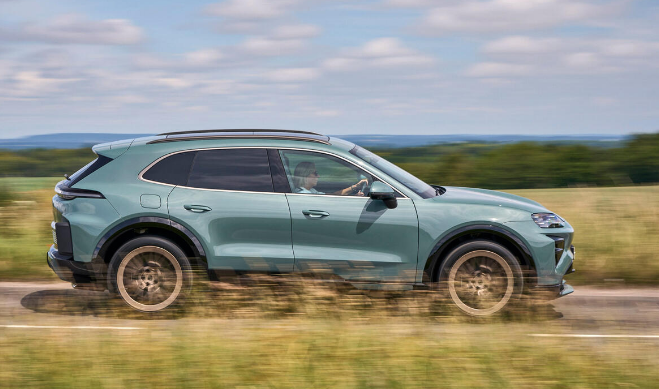
To understand the magnitude of this test, we must first look at the machines involved. On the tarmac, we have the Porsche Cayenne Electric, a vehicle that represents the pinnacle of the luxury electric SUV market. Packing an astonishing 1,139 horsepower, this battery-electric SUV is arguably the most capable vehicle the Stuttgart manufacturer has ever produced for public roads. Delivering instantaneous torque through an advanced dual-motor all-wheel-drive system, the Porsche Cayenne Electric is designed to offer supercar-level acceleration while maintaining the practicality of a premium family hauler.
In the sky—and on the runway—is the Stratolaunch Roc. With a wingspan of 385 feet, this twin-fuselage behemoth is a dedicated testbed aircraft utilized heavily by the hypersonic flight testing industry to launch rocket-powered vehicles into the upper atmosphere. Powered by six massive Pratt & Whitney engines, the Roc is a flying leviathan. The sheer air displacement, wake turbulence, and acoustic violence generated by this aircraft make it one of the most hostile environments imaginable for a ground vehicle attempting to drive alongside it.
The mission was simple in theory but incredibly complex in execution: the Porsche Cayenne Electric would pace the Stratolaunch Roc through a series of takeoff runs and landings to evaluate the SUV’s aerodynamic stability and high-speed handling characteristics.
Behind the Wheel: The Human Element of High-Speed Testing
Piloting a high-performance electric vehicle at speeds exceeding 160 mph is already a task that requires intense concentration. Doing so while essentially driving under the wing of a six-engine aircraft introduces variables that standard automotive proving grounds simply cannot replicate. To execute this, Porsche called upon former factory driver Patrick Long, a man intimately familiar with the limits of vehicle physics.
Long was tasked with keeping the Porsche Cayenne Electric perfectly aligned with the massive aircraft as it accelerated toward its rotation speed. “I had no doubts about the power of the Cayenne, but I was a bit apprehensive regarding how reactive the car would be to inputs, especially at speed,” Long noted following the tests.
His apprehension highlights a crucial aspect of modern EV design. In a luxury electric vehicle, the massive weight of the battery pack significantly alters the center of gravity and polar moment of inertia compared to a traditional internal combustion engine (ICE) vehicle. While the Porsche Cayenne Electric utilizes highly advanced torque vectoring and adaptive air suspension to mask its mass, traveling at 160 mph next to a turbulent vortex of jet wash tests the absolute limits of those digital and mechanical chassis control systems.
The Challenge of Visual References and Spatial Awareness
One of the most fascinating takeaways from this aerospace-automotive crossover test was the psychological and visual challenge faced by the driver. When pacing the Stratolaunch Roc during its landing phase, Long had to thread the Porsche Cayenne Electric directly between the aircraft’s twin-fuselage setup.
According to Long, the takeoff runs were intense, but the landings presented a completely different set of hurdles. “Surprisingly, the landings were a lot harder to time just right,” he explained. “The plane is so big that you don’t really have effective visual references for timing when to merge with the plane onto the runway.”
When an object the size of the Stratolaunch Roc fills your entire field of view, standard depth perception begins to fail. To mitigate the risk of under-shooting or over-shooting the aircraft, real-time telemetry and communication were vital. This coordinated testing required Shauntel Williams and John McKinney, the crew chiefs of the six-engine airplane, to ride directly inside the Porsche Cayenne Electric. Operating via encrypted radios, they maintained constant communication with the flight crew, bridging the gap between the cockpit of the aircraft and the cabin of the battery-electric SUV. With an FAA coordinator on site monitoring the safety parameters, this was a masterclass in cross-industry operational precision.
Aerodynamic Revelations: Finding the “Quiet Area”
From an engineering perspective, the most intriguing data point gathered during this exercise was the aerodynamic interaction between the two vehicles. Porsche engineers discovered that as the Porsche Cayenne Electric paced the massive aircraft, threading between the twin fuselages actually placed the SUV into a unique aerodynamic slipstream.
The team reported that the Porsche Cayenne Electric benefited from an unexpectedly “quiet area” between the fuselages. This pocket of stabilized air allowed the SUV to maintain its 160 mph cruising speed with far less aerodynamic drag than it would experience driving through undisturbed air.
For buyers investing in a high-performance electric SUV, aerodynamic efficiency is not just a buzzword; it is directly tied to the vehicle’s functional range and high-speed stability. The fact that the Porsche Cayenne Electric remained planted, predictable, and remarkably quiet under the turbulent canopy of a hypersonic flight testbed speaks volumes about the meticulous wind-tunnel tuning executed by Porsche’s design team. It proves that the active aero components on the vehicle—such as the adaptive rear spoiler and underbody airflow management—are capable of reacting to extreme, unpredictable environmental pressures in real time.
Battery Efficiency Under Extreme Load
Perhaps the most impressive statistic to emerge from the Mojave Air and Space Port tests was the energy consumption metric. High-speed driving is notoriously detrimental to EV battery efficiency. Unlike internal combustion engines, which often find a cruising efficiency sweet spot at highway speeds, electric motors draw exponentially more current to overcome the cubic increase in aerodynamic drag as speeds climb into the triple digits.
Yet, over the course of four high-speed, flat-out runs exceeding 160 mph, the Porsche Cayenne Electric consumed only 13 percent of its total battery capacity.
This single data point is a monumental achievement in EV thermal management and battery discharge optimization. For years, critics of electric vehicles have argued that sustained high-performance driving leads to immediate battery degradation, severe thermal throttling, and catastrophic range drop-off. The Porsche Cayenne Electric dismantles that narrative. By utilizing an advanced 800-volt battery architecture, the vehicle ensures that the massive current draw required to sustain 1,139 horsepower does not overwhelm the cooling systems.
For the modern consumer looking at the premium EV market, this translates directly to peace of mind. Whether you are navigating the high-speed expanses of the German Autobahn, undertaking a spirited drive through mountain passes, or simply relying on your luxury electric vehicle for daily commuting, the battery architecture in the Porsche Cayenne Electric is engineered to deliver repeatable, fade-free performance without leaving you stranded with a depleted battery.
What This Means for the Future of the Luxury EV Market
We are currently witnessing a golden age of automotive performance, driven by the rapid evolution of electrification. However, horsepower numbers are cheap in the EV era. Any manufacturer can strap massive motors to a skateboard chassis and achieve a sub-three-second 0-60 mph time. What separates a true legacy sports car manufacturer from a tech startup is how the vehicle behaves when the conditions become extreme.
The decision to test the Porsche Cayenne Electric alongside the Stratolaunch Roc was a deliberate statement. Porsche is signaling to the industry—and to its discerning customer base—that their transition to electric mobility does not compromise their motorsport pedigree. They are applying aerospace-grade testing standards to a battery-electric SUV that you can drive off a dealership lot today.
Furthermore, this test underscores the shifting landscape of high-CPC automotive technology sectors. As consumers become more educated, their search intents are moving away from basic metrics and toward complex queries like “electric vehicle battery longevity,” “high-performance electric SUV stability,” and “luxury EV charging infrastructure.” By proving that their flagship SUV can reliably execute four high-speed runs with a minimal 13% battery drain, Porsche is directly addressing the core anxieties of premium EV buyers: range anxiety and performance reliability.
Redefining the Grand Tourer
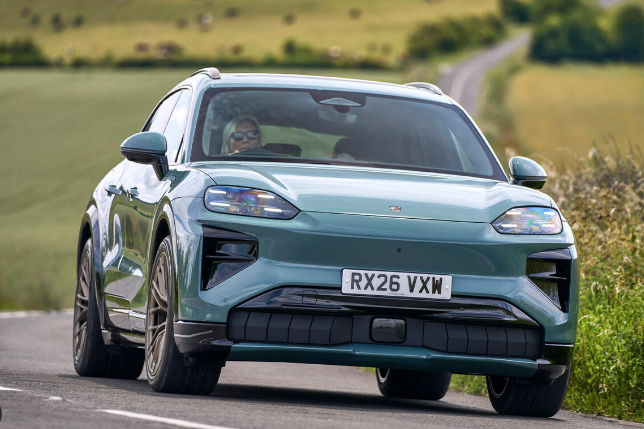
The Porsche Cayenne Electric is not just a vehicle; it is a technological showcase. This collaboration with the Stratolaunch team highlights a shared philosophy between cutting-edge automotive manufacturing and advanced aerospace engineering. Both industries demand absolute precision, peerless thermal management, and uncompromising aerodynamic efficiency.
By flawlessly pacing a 385-foot aircraft at rotation speeds, managing turbulent airframes, and maintaining incredibly low energy consumption under maximum load, the Porsche Cayenne Electric has set a new benchmark for what a battery-electric SUV can achieve. It proves that the future of driving is not merely about silent commuting; it is about expanding the boundaries of dynamic capability.
If this high-speed stunt in the Mojave Desert gives us any indication of where automotive engineering is heading, it is clear that the electric era will be anything but boring. The rules of motion are being rewritten, and vehicles like the Porsche Cayenne Electric are holding the pen.
Experience the Future of Performance Today
The engineering marvels demonstrated on the runway in Mojave aren’t just reserved for professional test drivers—they are built into every new vehicle rolling off the assembly line. If you are ready to experience the breathtaking acceleration, aerospace-grade stability, and unmatched luxury of the latest generation of electric vehicles, it is time to get behind the wheel yourself. Visit your local premium automotive dealership today to schedule a test drive of the new Porsche Cayenne Electric, and feel exactly what 1,139 horsepower of pure, unadulterated electric performance feels like on your local roads.