
The 2026 Porsche 911 GT3 S/C: Redefining the Track-Ready Convertible
For a quarter of a century, the arrival of a new GT-division Porsche has followed a strictly governed, purist formula. Unveiling a new track weapon from Weissach usually promises identical fundamental ingredients to the last, just amplified. Enthusiasts anticipate more mechanical grip, aggressive aerodynamic downforce, sharper turn-in response, and an unrelenting focus on lap times. The fixed-roof coupe layout has always been the non-negotiable bedrock of this homologation-bred lineage. So, when Porsche announced the 2026 Porsche 911 GT3 S/C—a soft-top convertible iteration of its most hallowed driver’s car—it felt like cinematic heresy. Imagine a flagship action movie franchise suddenly replacing its legendary lead actor with a completely different personality. How could a vehicle stripped of its race-derived, track-centric structural rigidity possibly justify wearing the GT badge?
To determine if a convertible GT3 is an inherent oxymoron, I traveled directly to Stuttgart. The mission was to ascertain whether the Porsche 911 GT3 S/C possesses the self-awareness required to be a genuine driver’s car, or if it is simply a compromised marketing exercise. The most pressing question, however, required an open mind: could this roofless variant actually deliver a more engaging experience than the standard coupe?
The Heresy of a Drop-Top Track Weapon
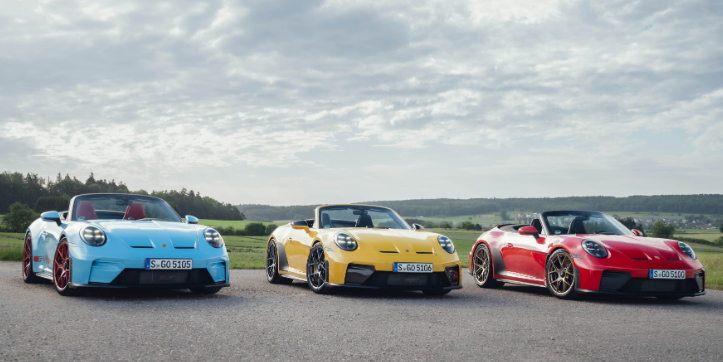
When pressing Andreas Preuninger, the notoriously exacting director of Porsche’s GT division, on the skepticism surrounding a roofless GT model, his response was immediate and uncompromising. He dismissed the notion that the Porsche 911 GT3 S/C dilutes the brand’s motorsport heritage.
Historically, automotive purists carry heavy baggage regarding convertible variants of thoroughbred sports cars. Chopping the roof off usually introduces a cascade of dynamic compromises. The structural bracing required to restore rigidity adds significant mass, blunting acceleration and altering the center of gravity. The resulting chassis flex—often felt as cowl shake over uneven pavement—detracts from steering precision. Furthermore, high-performance drop-tops often look distinctly awkward with their fabric roofs deployed. If you are browsing luxury sports cars for sale, you typically have to choose between ultimate canyon-carving capability and the theater of open-air motoring. Preuninger’s team set out to obliterate that compromise.
In its most distilled definition, the Porsche 911 GT3 S/C is essentially a GT3 Touring that has traded its aluminum roof for the sky. It retains the identical, naturally aspirated 4.0-liter flat-six engine and the glorious six-speed manual gearbox. Purists will rejoice to learn that the lightning-fast PDK transmission is strictly unavailable here; this car demands manual engagement.
The raw metrics speak to a breathtaking engineering achievement. The Porsche 911 GT3 S/C delivers 503 horsepower, launches from 0 to 62 mph in just 3.9 seconds, and charges to a top speed of 194 mph. Most astonishingly, it weighs in at just 1,497 kilograms. That means this fully automated cabriolet—whose roof stows in a mere 12 seconds—weighs only 36 kilograms more than its notoriously svelte manual Touring counterpart.
Structural Integrity and High-End Engineering
The assumption that the Porsche 911 GT3 S/C was a softened, floppy spin-off dictated by a marketing department looking to capitalize on wealthy sun-seekers is entirely false. The project originated directly within the GT engineering team, but Preuninger enforced two absolute mandates before green-lighting production: the vehicle had to weigh under 1,500 kilograms with all fluids aboard, and it had to meet the exact, uncompromising dynamic standards of the fixed-roof GT lineup.
To achieve this strict weight target, Porsche’s engineers extensively raided the parts catalog of the ultra-exclusive 911 S/T. The Porsche 911 GT3 S/C utilizes the S/T’s exotic carbon fiber doors, front wings, frunk lid, rear anti-roll bar, and sheer plate. Furthermore, it rides on the S/T’s ultra-lightweight forged magnesium wheels. Carbon ceramic brakes (PCCB) are fitted as standard equipment rather than an expensive option. Large sections of the convertible roof mechanism itself are cast from magnesium. These obsessive, aerospace-grade weight-saving measures completely offset the 40-kilogram penalty of the reinforced cabriolet body shell and the 36-kilogram roof hydraulic system.
Preserving track-ready dynamics required equal obsession. The brilliant double-wishbone front suspension architecture—a defining upgrade of the 992-generation GT3—was absolutely non-negotiable. However, fitting this hardware into a standard convertible shell posed a challenge. The engineers opted to use the wider, heavily reinforced body-in-white from the Carrera 4 cabriolet rather than the rear-wheel-drive Carrera 2. This specific chassis provided the necessary mounting points for the GT suspension, and the empty space normally occupied by the front differential allowed for an expanded fuel tank capacity.
The resulting torsional stiffness is rated at a remarkable 27,000 Nm/degree. This represents a massive 25 percent improvement over the older 991 GT3 Speedster and easily rivals modern fixed-roof sports cars built on dedicated aluminum architectures. Preuninger confidently asserts that it is entirely impossible for a driver to detect any chassis flex in the Porsche 911 GT3 S/C on public roads.
Powertrain Dynamics and Aerodynamic Stability
While the Porsche 911 GT3 S/C borrows heavily from the S/T, it does not adopt that model’s hyper-aggressive, single-mass flywheel. The S/C was designed with a slightly broader, more usable operational brief in mind, avoiding the clattery idle and stall-prone nature of a race-spec flywheel in stop-and-go traffic.
Aerodynamics present the greatest challenge for any convertible capable of nearly 200 mph. Standard drop-tops often generate between 150 and 200 kilograms of dangerous aerodynamic lift at Autobahn speeds, making the front end feel dangerously light. Weissach engineers circumvented this by retaining the full suite of flat-floor underbody aero strakes from the standard GT car. Combined with a subtle but highly effective gurney flap integrated into the rear tail design, the Porsche 911 GT3 S/C actually generates 16 kilograms of positive downforce at high speed. It remains absolutely glued to the tarmac.
The interior configuration also plays a critical role in the vehicle’s dynamic communication. Specifying the fixed-back carbon bucket seats over the heavier, 18-way adjustable electric comfort seats is virtually mandatory. The suspension’s high-speed damping algorithms were explicitly tuned to harmonize with the specific resonance and rigidity of the carbon shells. The tactile feedback transmitted straight through the chassis into the driver’s seat is a foundational element of the GT experience.
Fascinatingly, due to slight kinematic adjustments and a uniquely optimized front-to-rear weight distribution, Preuninger revealed that the Porsche 911 GT3 S/C is genuinely the most drift-happy and playful vehicle in the current GT portfolio. His definition of the GT badge is illuminating: it does not merely mean homologation racetrack focus, but rather “the most connected, immersive driving experience for either road or track.” By removing the roof, you eliminate the barrier between the driver, the mechanical symphony of the flat-six, and the rushing atmosphere, elevating that visceral connection.
First Drive Impressions: Recalibrating the Senses
Climbing into a meticulously specified Slate Grey Neo Porsche 911 GT3 S/C as dawn broke over the German countryside, the cabin felt instantly welcoming. Porsche’s ergonomic perfection remains unmatched; the analog tachometer dominates the instrument cluster, and the physical switchgear is positioned exactly where muscle memory expects it. You can achieve a flawless driving position regardless of your height.
However, my initial miles behind the wheel were shockingly clumsy. Attempting to follow the lead camera car, I found myself unable to execute a smooth gear change, modulate the brakes gracefully, or feed in throttle without lurching. To compound the embarrassment, I stalled the flat-six while pulling out of a scenic lay-by. I felt like a novice driver grappling with their first manual transmission, rather than an automotive journalist evaluating one of the finest track-ready convertibles on the market.
The roads an hour south of Stuttgart are a driver’s paradise—smooth, sweeping A-roads cutting through spectacular, traffic-free topography. Yet, pulling out for a high-speed overtake required finding third gear mid-maneuver. As my right hand left the Alcantara steering wheel to row the shifter, the front tires caught a subtle road camber. Without two hands firmly managing the hyper-sensitive steering rack, the car darted off-line with alarming immediacy. The 0 to 62 mph time might seem quaint compared to electric hypercars, but the Porsche 911 GT3 S/C is devastatingly fast in the real world. At maximum attack, deviations in steering trajectory are not trivial.
The epiphany arrived shortly after. I had spent the previous week wrestling a 45-year-old vintage classic across Europe—a machine that required heavy, deliberate, and forceful inputs to the steering, clutch, and brakes. The Porsche 911 GT3 S/C is the antithesis of vintage brute force. It is honed to a microscopic tolerance. The controls do not want to be shoved or hauled; they demand telepathic, fingertip precision.
Finding the Rhythm on the Open Road
Navigating the tighter, heavily heavily-forested switchbacks of the Schwäbische Alb highlighted the true character of this machine. If you are expecting a relaxed, open-air grand tourer capable of lazily mooching through wine country, you will be deeply unsettled. The Porsche 911 GT3 S/C behaves like a tightly coiled predator. Even when crawling through a village, the car quivers on its haunches, the drivetrain taut, aggressive, and impatient for the national speed limit sign.
Every interface in the Porsche 911 GT3 S/C is designed for maximum, bidirectional communication. The steering rack telegraphs every pebble; the brake pedal requires firm, measured pressure; the throttle maps directly to your synapses. At anything less than eight-tenths of its capability, the car feels restless. There is a palpable tension between the ultra-stiff damping, the aggressive engine mapping, and the slow pace of civilian traffic. The harmonic fluency of the suspension and powertrain only unlocks when you push the chassis hard.
It took hours of focused driving to finally sync my inputs to the car’s frantic frequency. We tested a second vehicle to confirm a slight hesitation at partial throttle in the mid-range—a common trait in highly strung, naturally aspirated engines tuned for peak emissions compliance. But the moment you pin the throttle to the firewall, that hesitation evaporates, replaced by an ear-splitting, 9,000-rpm mechanical shriek that echoes off the canyon walls in a way no closed-roof GT3 can match.
Navigating the High-End Market: Allocations and Ownership
Understanding the Porsche 911 GT3 S/C requires contextualizing it within the broader 2025/2026 automotive market. Securing an allocation from luxury auto dealers in high-demand affluent hubs like Miami, Los Angeles, or New York is an exercise in extreme patience and dealership relationship management. This is not a vehicle you simply walk in and purchase at MSRP.
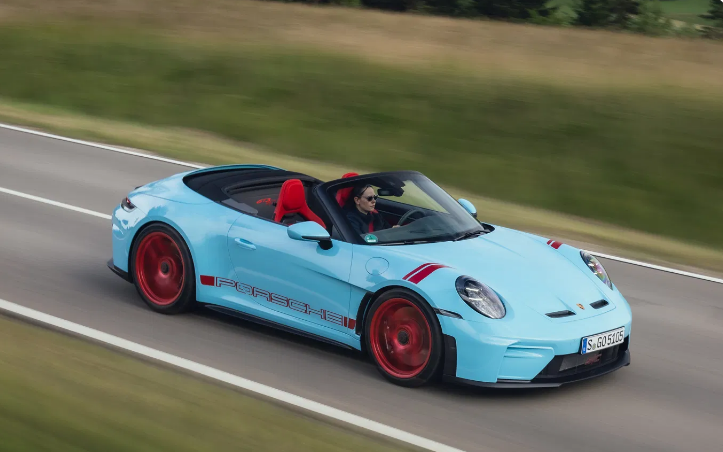
For buyers exploring high-performance convertible financing or specialized Porsche lease deals, the financial reality of the GT division remains unique. Historically, naturally aspirated, manual-transmission Porsche GT products suffer from virtually zero depreciation, often trading at substantial premiums on the secondary market. However, prospective owners must accurately calculate their running costs. Due to the standard carbon ceramic brakes (which cost upwards of $10,000 to replace), the bespoke magnesium roof structure, and the sheer performance envelope of the vehicle, exotic car insurance rates for the Porsche 911 GT3 S/C will be significantly higher than a standard Carrera Cabriolet. Yet, for the target demographic evaluating the best luxury sports cars for sale, these premiums are a small price to pay for unparalleled analog engagement.
The Final Verdict on the Drop-Top GT3 Experience
With just fifteen minutes remaining before my shuttle to the airport, the neural pathways finally clicked. Slicing out of a quiet German village at 30 km/h, the car was once again practically vibrating with kinetic tension. As the derestricted Autobahn sign flashed past, I dropped into second gear and buried the throttle.
The rear tires hooked up flawlessly, the multi-link front suspension tracked perfectly true, and the flat-six howled toward its stratospheric redline with the roof down and the wind rushing through the cabin. In that singular moment, every ounce of skepticism regarding the compromised nature of convertibles vanished. By marrying the razor-sharp precision of Weissach engineering with the unfiltered sensory overload of open-air motoring, Porsche hasn’t just built a credible track car without a roof. They have engineered arguably the most intense, emotionally resonant road car in their entire lineup.
If you are ready to experience the pinnacle of naturally aspirated engineering and want to understand why this chassis commands such legendary respect, do not settle for reading about the redline. Reach out to your local Porsche authorized dealership today to discuss upcoming allocations, explore bespoke Paint to Sample options, and secure your place in the driver’s seat of automotive history.