
Behind the Wheel of the 2026 Toyota Land Cruiser Commercial: The Ultimate Tax-Busting 4×4 Cargo Rig
If you venture far enough into the world’s most unforgiving environments—from the sun-scorched expanse of the Australian Outback to the jagged, shifting dunes of the Sahara—you will inevitably encounter a familiar silhouette. In regions where a mechanical failure isn’t just an inconvenience but a genuine threat to your survival, Toyota’s premier off-roader reigns supreme. Its reputation for bulletproof reliability and raw mechanical endurance is unparalleled. When I recently spent time in Morocco evaluating the latest EV platforms, the sheer volume of trail-battered, expedition-ready Cruisers navigating the harsh terrain served as a stark reminder of this vehicle’s enduring global legacy.
But there is a highly specialized, distinctly European offshoot of this legendary 4×4 dynasty that most American buyers will never see on local dealership lots. Enter the Toyota Land Cruiser Commercial—a dedicated cargo conversion of the highly anticipated “J250” generation. In several overseas markets, this vehicle rolls out with its second- and third-row seating entirely stripped out, replacing passenger comfort with a cavernous, flat-floored load space. Interestingly, this transformation doesn’t happen on the assembly lines in Japan. Instead, it arrives in the United Kingdom as a standard passenger SUV and undergoes a meticulous post-production teardown and retrofit at Toyota’s manufacturing facility in Derbyshire, the exact same plant responsible for churning out the U.S.-bound GR Corolla.
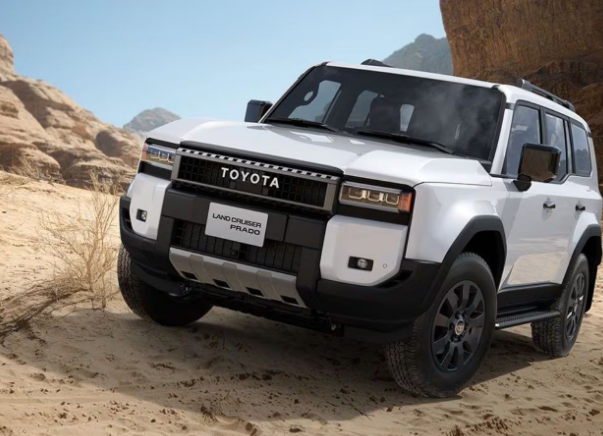
As a fleet industry veteran with over a decade of analyzing commercial vehicles, I can tell you that the Toyota Land Cruiser Commercial isn’t simply an exercise in maximizing cargo volume. Its primary engineering objective is deeply rooted in financial strategy.
The Economics of the Commercial SUV Conversion
To understand the existence of the Toyota Land Cruiser Commercial, you have to understand the complex landscape of international business vehicle tax deductions and fleet vehicle financing. While this rig certainly accommodates bulkier, awkwardly shaped loads better than its standard passenger counterpart, the core motivation for its creation is aggressive tax mitigation.
In the U.K., the Republic of Ireland, and several other European jurisdictions, businesses and fleet operators are heavily incentivized to purchase classified commercial vehicles. Professionals utilizing vans for trade purposes pay exponentially less in annual tax for incidental “private” use compared to traditional passenger cars. Furthermore, the initial purchase taxes and ongoing commercial auto insurance rates often heavily favor homologated cargo vehicles.
Let’s look at the raw numbers. In Britain, operating the Toyota Land Cruiser Commercial subjects the owner to a modest £345 (roughly $460) annual Vehicle Excise Duty (VED). Conversely, a buyer opting for the standard passenger variant faces a punitive £5,490 (around $7,340) VED charge for the first year. That delta is impossible for a shrewd business owner to ignore. It is precisely why off-road cargo van conversions are becoming an incredibly lucrative niche. Competitors like Land Rover and Ineos are aggressively targeting this exact demographic with stripped-out, commercial-grade iterations of the Defender and Grenadier. The B2B fleet sales market for a 4×4 commercial vehicle is thriving, driven by buyers who demand heavy-duty off-road capability coupled with aggressive tax write-offs reminiscent of the Section 179 tax deductions utilized by heavy equipment operators in the United States.
Luxury Meets Utilitarian Design
Getting up close to the Toyota Land Cruiser Commercial, the vehicle’s dual identity becomes immediately apparent. This is a machine caught between luxury passenger heritage and blue-collar utility. The rear passenger doors still retain their factory glass, but the windows are permanently fixed. Behind the glass, heavy-duty opaque panels have been installed to protect the interior from shifting pallets and heavy cargo.
The interior modifications showcase a fascinating blend of high-end technology and strict compliance engineering. Inside the rear side doors, the original power window motors are still physically present behind the door cards, but the operational switches have been replaced with permanent blanking plates. The driver’s door switchgear features similar plastic caps over the rear window toggles. In the cargo bay, overhead grab handles and passenger seatbelts have been entirely deleted. Yet, in a quirky nod to its passenger-car origins, the molded plastic side panels in the rear still feature the third-row cupholders.
Toyota knows that some buyers might be tempted to exploit the tax loophole by purchasing the Toyota Land Cruiser Commercial and illicitly reinstalling aftermarket seats. To prevent this, the factory physically cuts away the structural mounting points for the rear bench before laying down the heavy-duty, flat commercial load floor. The cargo area is further upgraded with multiple high-tensile lashing rings for securing heavy freight and a robust, full-height steel mesh bulkhead that safely separates the payload from the front occupants.
Because it shares its DNA with the heavily optioned European-spec model, the Toyota Land Cruiser Commercial boasts a bizarrely premium equipment list for a work truck. It retains the power-operated rear tailgate, complete with a glass upper section that opens independently. Granted, without a traditional trunk layout, dropping small items through the glass to the low cargo floor isn’t particularly ergonomic. Up front, the driver and single passenger are treated to power-adjustable, heated, and ventilated seats, alongside a premium audio system, a massive infotainment display, and advanced radar adaptive cruise control. From the front seats forward, it feels like a premium executive SUV; look over your shoulder, and it’s a hardened delivery rig.
Exploring the 2.8-Liter Turbodiesel Powertrain
For driving enthusiasts, securing time behind the wheel of a European-market Toyota Land Cruiser Commercial offers a rare opportunity to test a powertrain that remains strictly forbidden fruit in the North American market. Under the hood sits a remarkably resilient 2.8-liter turbocharged inline-four diesel engine. In the global theater of extreme off-roading, this specific engine is widely considered the gold standard for remote expeditions due to its mechanical simplicity and thermal efficiency.
For the 2026 iteration, this 2.8-liter powerplant generates a peak output of 202 horsepower and a stump-pulling 369 lb-ft of torque. Toyota has subtly modernized the powertrain by integrating a 48-volt mild-hybrid system, which smooths out the stop-start function and provides a fractional torque fill low in the rev range to improve initial throttle response. On paper, 202 horsepower might seem underwhelming against the vehicle’s substantial 5,200-pound unladen curb weight. However, spec sheets rarely tell the whole story. Because that peak 369 lb-ft of torque is fully accessible from a remarkably low 1,600 rpm, and the recalibrated eight-speed automatic transmission manages the powerband with exceptional intelligence, the Toyota Land Cruiser Commercial rarely feels sluggish in real-world driving.
That said, this four-cylinder turbodiesel is a gruff, unapologetically industrial companion. When benchmarked against the remarkably smooth inline-six diesels currently offered in European-spec Defenders, the Toyota’s power plant shows its utilitarian roots. At a cold idle, noticeable vibration permeates the cabin, and under heavy throttle applications, the diesel clatter is prominent. It also exhibits a classic diesel aversion to high RPMs. Left in standard automatic mode, the transmission computer stubbornly refuses to let the engine spin past 3,800 rpm before executing a crisp upshift, even when the accelerator is pinned to the floorboard. If you want to force the digital tachometer anywhere near its indicated 4,400-rpm redline, you have to engage the transmission’s manual mode.
But once you settle into a steady highway rhythm, the acoustic refinement improves significantly, easily outpacing the NVH (Noise, Vibration, and Harshness) levels of a standard tin-sided panel van. Toyota officially claims a 0-to-62 mph sprint of 10.2 seconds. It is a metric that exactly zero fleet operators will ever care to verify, especially since heavy acceleration causes the rig to squat dramatically on its rear suspension, adopting a pronounced nose-up posture. Highway cruising is comfortable, though the chunky Dunlop AT23 Grandtrek all-terrain tires tend to wander slightly at high speeds, reminding you that this vehicle was optimized for dirt, not the autobahn.
Payload, Towing, and Off-Road Prowess
Like traditional body-on-frame trucks, the Toyota Land Cruiser Commercial exhibits vastly improved driving dynamics when hauling a payload. Driven unladen, the heavy-duty rear suspension feels slightly underdamped over broken pavement, transmitting sharp impacts and lateral jitters into the cabin. However, once we strapped a dense 220-pound piece of industrial equipment into the cargo bay, the chassis settled beautifully, absorbing mid-corner undulations and broken tarmac with the composed, tank-like solidity the brand is famous for.
Where this commercial SUV conversion truly eclipses any standard transit van is off the pavement. The Toyota Land Cruiser Commercial retains every single piece of elite off-road hardware found in the passenger version. It features a robust two-speed transfer case for low-range crawling, a manually locking center differential to split torque evenly in low-traction environments, and Toyota’s proprietary traction-management software designed to keep forward momentum alive when mechanical grip vanishes. Whether you are a utility company surveying remote power lines, a construction manager navigating a deeply rutted job site, or an agricultural contractor traversing muddy fields, this vehicle provides an unmatched layer of operational security.
It is important to objectively analyze its limitations as a dedicated cargo hauler. As a pure van, the Toyota Land Cruiser Commercial has inherent compromises. The interior load space measures 66.4 inches in length, 50.6 inches in width, and 42.9 inches in height. While the volume is generous, the high load floor—dictated by the heavy-duty live rear axle and off-road ground clearance—makes loading heavy or awkwardly shaped pallets significantly more difficult than sliding them into a low-floor Transit. Furthermore, the massive top-hinged tailgate demands a large footprint to open fully, which can be highly impractical in tight loading docks where traditional dual side-hinged barn doors would excel.
Yet, nobody signs a commercial vehicle financing contract on a Toyota Land Cruiser Commercial because it’s a direct alternative to a standard city delivery van. They buy it for its brute strength. It boasts a payload capacity of up to 1,780 pounds in the rear bed, far exceeding what a standard passenger SUV can safely carry with the seats folded flat. More importantly, it features a massive 7,700-pound towing capacity—the absolute maximum legal limit for a vehicle in this weight class under strict European transport regulations.

Priced at £50,640 (roughly $67,800) before taxes, the Toyota Land Cruiser Commercial severely undercuts the cheapest passenger-carrying equivalent by nearly £9,000 ($12,000). For fleet operators and business owners requiring bulletproof reliability, heavy-duty towing, extreme off-road capability, and massive tax advantages, this highly specialized cargo rig is a masterpiece of market engineering. It sacrifices seating capacity, but in return, it delivers one of the most capable, durable, and financially savvy commercial tools on the global market.
If you are a business owner evaluating your fleet acquisition strategy for the upcoming fiscal year, don’t let outdated purchasing habits cost you thousands in lost tax deductions and operational downtime. Contact your local commercial fleet specialist today to see how integrating a heavy-duty 4×4 commercial vehicle can revolutionize your bottom line.