
When 1139 Horsepower Meets the Sky: The Porsche Cayenne Electric and the Stratolaunch Roc in a High-Speed Masterclass
As an automotive industry analyst and test engineer with over a decade spent evaluating high-performance vehicle dynamics, I have seen my fair share of manufacturer publicity stunts. We have all witnessed the heavily edited, gimmick-laden drag races where a supercar goes head-to-head with a fighter jet. But the automotive sector rarely delivers an event that genuinely pushes the boundaries of real-world physics, aerodynamics, and multi-disciplinary engineering. That changed recently at the Mojave Air and Space Port.
In a breathtaking display of sustained high-speed stability and cutting-edge EV battery performance, the highly anticipated Porsche Cayenne Electric was put to the ultimate test. It did not just race an aircraft; it engaged in a meticulously choreographed, side-by-side technical ballet with the Stratolaunch Roc—the world’s largest flying plane. This was not a quarter-mile sprint for YouTube views. It was a rigorous assessment of how the Porsche Cayenne Electric handles sustained triple-digit speeds, massive aerodynamic disruption, and immense battery load, proving that the modern luxury electric SUV has entirely transcended the limitations of early EV technology.
The Anatomy of a Groundbreaking High-Speed EV Testing Event
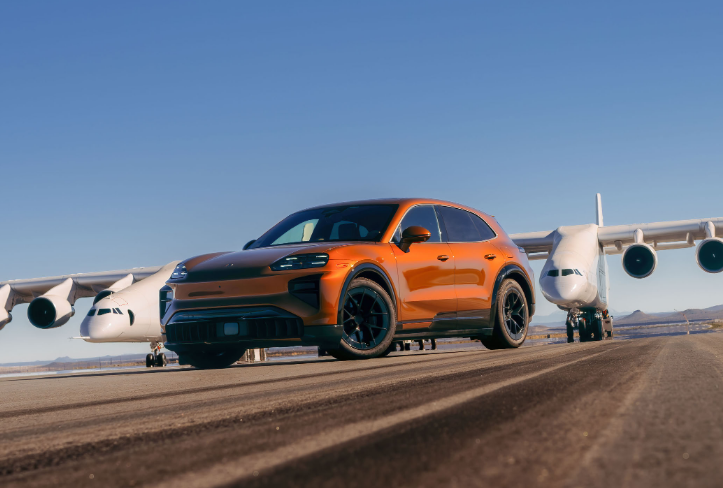
To understand the magnitude of this test, we must first look at the players involved. On the aviation side, we have the Stratolaunch Roc, an absolute leviathan of the skies. Built as a dedicated testbed aircraft by the hypersonic flight testing firm, the Roc features an unprecedented twin-fuselage design and is powered by six massive Pratt & Whitney engines. It is designed to haul and launch rocket-powered aircraft from high altitudes.
On the ground, we have the Porsche Cayenne Electric. Generating a colossal 1139 horsepower, this electric SUV is the most powerful model the Stuttgart manufacturer has ever put into production. When Porsche decided to evaluate the high-speed aerodynamic stability and thermal management of the Porsche Cayenne Electric, they didn’t just rent a closed track in Germany. They took it to the sprawling runways of Mojave, coordinating with the Stratolaunch team to see if this luxury electric SUV could match the takeoff rotation speeds and landing velocities of the world’s largest aircraft.
Piloting the Porsche Cayenne Electric was none other than Patrick Long, a highly respected former Porsche factory driver whose resume demands absolute respect in the paddock. His objective was clear but incredibly complex: pace the Stratolaunch Roc through multiple takeoff runs, exceeding speeds of 160 mph, and then mirror the aircraft’s exact trajectory as it came in for a landing, literally threading the luxury SUV between the massive aircraft’s twin fuselages.
The Physics of Chasing a Leviathan
From an engineering perspective, traveling at 160 mph alongside an aircraft generating immense thrust and wake turbulence is a masterclass in chassis tuning and aerodynamic stability. Having driven high-performance electric vehicles on test tracks around the globe, I can attest that triple-digit speeds amplify every single input. A millimeter of steering wheel movement or a slight crosswind can violently unsettle a vehicle.
“I had no doubts about the power of the Porsche Cayenne Electric, but I was a bit apprehensive regarding how reactive the car would be to inputs, especially at speed,” Long noted after the runs. His apprehension was entirely justified. When an aircraft of the Roc’s magnitude touches down, the ground-effect turbulence is staggering. However, the Porsche Cayenne Electric showcased flawless adaptive air suspension and active aerodynamic management, keeping the SUV planted to the tarmac.
Interestingly, the Porsche engineering team discovered a unique aerodynamic phenomenon during the landing phase. As Long piloted the Porsche Cayenne Electric between the Roc’s twin fuselages, the electric SUV actually benefited from a localized, aerodynamically quiet slipstream. This low-pressure zone between the aircraft’s hulls allowed the Porsche Cayenne Electric to slice through the air with reduced drag, demonstrating how highly engineered automotive profiles interact with external fluid dynamics.
Communication and Coordination at the Limit
A test of this magnitude requires flawless telemetry and human coordination. You cannot simply point a luxury electric SUV down a runway and hope to match the speed of a six-engine aircraft. The margin for error is essentially zero. To ensure absolute precision, Stratolaunch crew chiefs Shauntel Williams and John McKinney rode shotgun inside the Porsche Cayenne Electric.
Operating under the watchful eye of an on-site FAA coordinator, the crew chiefs maintained continuous radio contact with the flight deck of the Roc. This real-time telemetry allowed Long to adjust his throttle inputs with millimeter precision. The immediate, lag-free torque delivery of the Porsche Cayenne Electric proved vital here. Unlike an internal combustion engine, which must cycle through gears and build revs, the electric powertrain delivers instantaneous force. This allowed Long to perfectly match the aircraft’s rotation speed without overshooting or lagging behind.
“Surprisingly, the landings were a lot harder to time just right,” Long explained. “The plane is so big that you don’t really have effective visual references for timing when to merge with the plane onto the runway. I’m grateful that we had the crew chiefs ride along and communicate directly with the flight crew so we wouldn’t under- or over-shoot the plane.”
Battery Efficiency Under Maximum Load
While the visual spectacle of the Porsche Cayenne Electric racing alongside the Roc is stunning, the most impressive takeaway for industry insiders like myself revolves around EV battery performance and thermal management. Driving a vehicle weighing over 5,000 pounds to speeds exceeding 160 mph requires a gargantuan discharge of electrical current. In early generation electric vehicles, this kind of sustained high-voltage draw would result in immediate thermal throttling, where the car limits power to protect the battery pack from overheating.
The Porsche Cayenne Electric suffered no such degradation. The 1139 horsepower remained constantly accessible throughout the demanding Mojave test. Even more astonishing is the energy consumption data. Over the course of four flat-out runway runs, the Porsche Cayenne Electric utilized just 13 percent of its total battery capacity.
Let that sink in. Pushing a massive, ultra-luxury SUV to 160 mph repeatedly against the wake turbulence of a mega-plane only depleted a fraction of its charge. This metric speaks volumes about the advanced 800-volt architecture and energy-dense battery chemistry Porsche has implemented. For the everyday consumer, this translates to profound confidence in highway passing power, extended driving ranges, and exceptional efficiency. If the battery can handle multiple VMAX runs in the desert without severe depletion, it will easily manage premium EV charging solutions and long-distance road trips with range to spare.
Market Implications for Luxury Electric Vehicles
The automotive landscape has shifted dramatically by 2025 and 2026, with the high-end sector increasingly dominated by electrons rather than hydrocarbons. The Porsche Cayenne Electric is not just a technological flagship; it represents a critical pivot point in luxury automotive commerce.
When buyers enter this market bracket, they are scrutinizing more than just 0-60 times. They are looking at the entire ownership ecosystem. The reliability and thermal endurance demonstrated at Mojave make the Porsche Cayenne Electric a prime candidate for those exploring luxury electric SUV leasing. Leasing a high-performance EV has become incredibly popular as it allows drivers to experience cutting-edge battery technology while insulating themselves from long-term depreciation.
Furthermore, from a financial planning perspective, proving the structural integrity and stable handling of such a high-output vehicle has direct implications on EV auto insurance. High-horsepower electric vehicles historically command higher premiums due to the cost of battery replacement and the risks associated with rapid acceleration. However, the advanced active safety systems, precision handling, and predictable power delivery shown by the Porsche Cayenne Electric in such a high-stakes environment provide insurers with data points that justify more competitive premium EV auto insurance rates for qualified drivers.
Buyers are also actively looking into electric vehicle tax credits and regional incentives. As federal and state regulations continue to encourage zero-emission adoption, investing in a top-tier electric vehicle often unlocks significant financial benefits, offsetting the premium purchase price. Whether it is through favorable luxury car leasing terms or specialized high-coverage auto insurance packages, the ownership model for a vehicle of this caliber is becoming highly optimized.
The Future of Performance SUVs
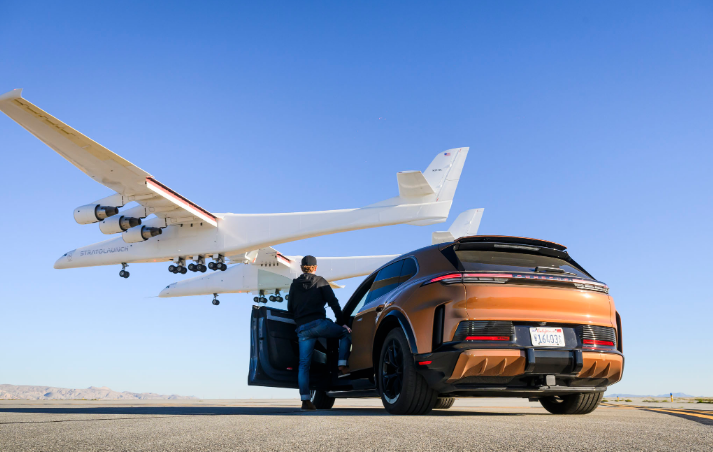
Mixing an experimental aerospace vehicle with a high-speed runway test of the new Porsche Cayenne Electric is the kind of bold engineering exercise that pushes the entire industry forward. It forces competitors to look beyond simple drag strips and evaluate how their vehicles perform in complex, dynamic, real-world environments.
We are witnessing the death of the compromise. For decades, automotive engineers had to choose between luxury, size, and absolute track-ready performance. The Porsche Cayenne Electric proves that with advanced torque vectoring, instantaneous electric power, and world-class thermal battery management, you can have a spacious, ultra-luxurious SUV that confidently paces a hypersonic testbed aircraft at 160 mph.
This test at Mojave cements the Porsche Cayenne Electric as a monumental achievement in automotive engineering. It is not just about raw speed; it is about absolute control, repeatable performance, and incredible energy efficiency under extreme duress. It is a vehicle that respects the legacy of Stuttgart’s racing heritage while firmly planting its flag in the electrified future.
If you are evaluating the current landscape of high-performance EVs, reading about these specifications is only half the equation. The sheer, relentless pull of 1139 electric horsepower combined with precision chassis dynamics must be felt firsthand to be truly understood. I highly recommend reaching out to your local Porsche dealership today to schedule a personalized test drive and explore the current luxury electric SUV leasing options available for the remarkable Porsche Cayenne Electric. Step into the driver’s seat and experience the future of high-speed luxury for yourself.