
Porsche 992 GTS T-Hybrid vs 997 GTS: A Modern Classic Meets an Electrified Icon
Over my decade of testing high-performance machines across the globe, few bloodlines have commanded as much respect—and provoked as much debate—as the Porsche 911 Carrera GTS. When you spend ten years evaluating the finest automotive engineering, you start to see patterns in how automakers transition between eras. The champagne corks must have been flying high over Stuttgart the day the engineering team conceptualized the original Porsche 911 Carrera GTS. At the time, they needed a graceful way to bring the 996 and 997 generations—the pioneers of the water-cooled era—in for a smooth landing. Looming on the horizon was a completely new breed of 911, one sporting a longer wheelbase, electric power steering, and a modernized ethos.
Sure, the market had already seen plenty of low-volume, high-dollar specials. Cars like the GT2 RS, the GT3 RS 4.0, the Speedster, and the retro-inspired Sport Classic were keeping the brand on the front covers of every automotive magazine. But what the corporate brass truly desired was a highly profitable, low-development-cost strategy to keep inventory moving swiftly out of local Porsche dealerships. So, they dusted off a legendary three-letter badge—first worn by the stunning 904 GTS racer in the 1960s and largely dormant since the grand-touring 928 GTS of the 1990s—and went rummaging through the factory parts bin.
A Modest Upgrade, A Massive Market Impact
When they opened the warehouse doors, the engineers wisely decided to leave the hardcore GT3 components alone. The Porsche 911 Carrera GTS didn’t need uncompromising motorsport aerodynamics or bone-rattling suspension setups. Instead, this new trim became the very first non-motorsport production 911 to marry the aggressive wide-body shell with a pure rear-wheel-drive layout—though, technically, both features had made brief appearances on the ultra-exclusive Sport Classic and Speedster.
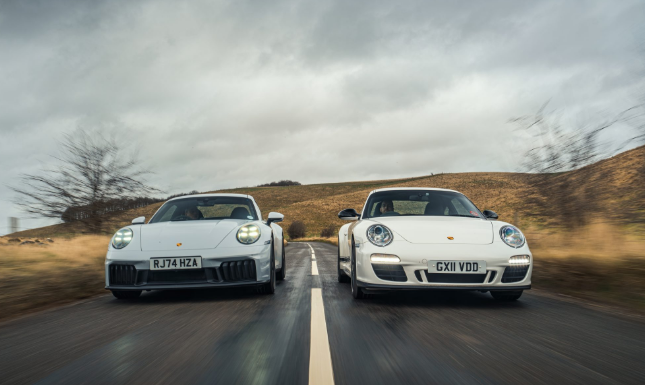
The powertrain was essentially lifted from the Sport Classic, though savvy buyers knew it was practically identical to a standard Carrera S equipped with the coveted factory ‘Powerkit’ option. To sweeten the deal, a throaty sports exhaust system and Porsche Active Suspension Management (PASM) adaptive dampers were thrown in as standard equipment rather than pricey add-ons. However, the truly track-focused hardware—like the lowered sport suspension, carbon-ceramic brakes, and a mechanical limited-slip differential—remained strictly on the options list.
Aesthetically, buyers were treated to a revised front splitter, motorsport-inspired center-lock alloy wheels, a thicker Sport Design steering wheel, generous applications of grippy Alcantara, a no-cost rear-seat delete option, and a subtle smattering of GTS badging. To understand how low-stakes this experiment originally was, consider the pricing: upgrading from a Carrera S to a Porsche 911 Carrera GTS back then cost just a few thousand dollars. It was an absolute bargain in the realm of high-end sports cars.
Enter the 2025 Era: The 992 Carrera GTS T-Hybrid
Fast forward to the modern era, and the automotive landscape has shifted radically. If you are browsing luxury sports cars for sale today, the new 992 Carrera GTS T-Hybrid stands as a towering technological achievement. Let’s compare it to the current Carrera S. While the S retains the familiar twin-turbocharged 3.0-liter flat-six pushing out 473 horsepower, the new Porsche 911 Carrera GTS introduces a groundbreaking 3.6-liter engine mated to a sophisticated hybrid system, generating a staggering 533 horsepower and 450 lbs-ft of torque.
The integration of hybrid technology shaves 0.3 seconds off the 0-60 mph sprint. In the traction-limited universe of rear-wheel-drive performance cars, shaving three-tenths of a second is monumental. But perhaps the most jarring change is the financial barrier to entry. The price gap between the S and the GTS has ballooned to over $16,000, although this premium now includes previously optional tech like rear-wheel steering.
If you want proof of how vital this “parts-bin special” has become to the brand’s bottom line, consider its launch strategy. The Porsche 911 Carrera GTS wasn’t saved for the tail-end of the 992.2 generation’s lifecycle; it was the lead car. The GTS moniker has exceeded even Stuttgart’s wildest sales projections. For buyers navigating Porsche 911 financing or exploring exotic car leasing, the GTS has become the definitive sweet spot of the lineup, holding immense residual value and delivering supercar-slaying performance.
But how does it actually feel? Numbers on a spec sheet are one thing, but out on the asphalt—on the winding, sun-baked Southern California canyon roads where these machines are truly tested—does it retain its soul? Over a four-day testing period, it was my professional duty to find out.
A Mid-Spec Model with Serious Firepower
Every single journalist, driver, and enthusiast who climbs out of the new Porsche 911 Carrera GTS for the first time repeats a variation of the exact same phrase: “I simply cannot believe how incredibly fast that is.”
I was no different. During the initial press drives, the way this car erupted off the line genuinely recalibrated my internal G-force sensors. It wasn’t until a lead powertrain engineer explained the hybrid architecture that it made sense. Thanks to the electric motor spooling the turbocharger and providing instant torque fill, the new Porsche 911 Carrera GTS is actually quicker off the line over the first 60 feet than the almighty 911 Turbo S. It absolutely feels like it, pinning you into the carbon bucket seats with violent immediacy.
The natural follow-up question is, of course, “What on earth will the next Turbo S feel like?” But while we wait for that ballistic missile to arrive, I can confidently state that during my entire time with the GTS, I never once wished for another horsepower. It already packs more punch than the legendary 997 Turbo S, which was the undisputed king of its generation.
While the Porsche 911 Carrera GTS is theoretically a “mid-tier” model, it is effectively the most potent rear-wheel-drive 911 you can buy until a new GT2 RS eventually breaks cover. As before, you can spec your Porsche 911 Carrera GTS with rear- or all-wheel drive, and choose between a coupe, cabriolet, or Targa roof. The only casualty of this technological leap? The manual transmission. Due to the complex integration of the hybrid drive unit inside the gearbox housing, a stick shift is no longer physically possible. As a purist, I understand the engineering constraints, but it remains a heartbreaking loss for driving enthusiasts.
Versatility Meets Raw, Unadulterated Speed
The true magic of the 992-generation Porsche 911 Carrera GTS lies in its duality. It possesses distinctly different personalities, which is remarkable given the aggressive spec of my test car: fixed-back carbon bucket seats, rear-seat delete, lightweight noise-insulating glass, and aggressive premium performance tires.
Despite the track-focused hardware, the car can comfortably masquerade as a daily driver. The modernized cabin features a crisp new fully digital instrument cluster, a central infotainment display that feels as responsive as a flagship smartphone, and customizable hotkeys that allow you to quickly disable intrusive lane-keep assists and modern safety nannies. It is as user-friendly and accommodating as anyone could expect a modern performance car to be.
But when the coastal highway opens up and you want to push the envelope, the transformation is instantaneous. There is an ocean of torque available at any RPM. Flick the steering-wheel-mounted drive mode dial into ‘Sport’, and the throttle response sharpens to a razor’s edge. I highly recommend taking manual control of the PDK transmission via the paddles; if left in automatic, the gearbox is almost too eager to drop three gears when you only need a slight surge of momentum, seemingly unaware of just how much grunt the hybrid 3.6-liter produces on its own.
Push through the polite daily-driving phase and you enter the wild west of modern hybrid performance. It feels almost absurd to write this about a Carrera-level car, but the sheer brutality and relentless acceleration of the new Porsche 911 Carrera GTS are nothing short of breathtaking.
Behind the Wheel of the Analog 997 GTS
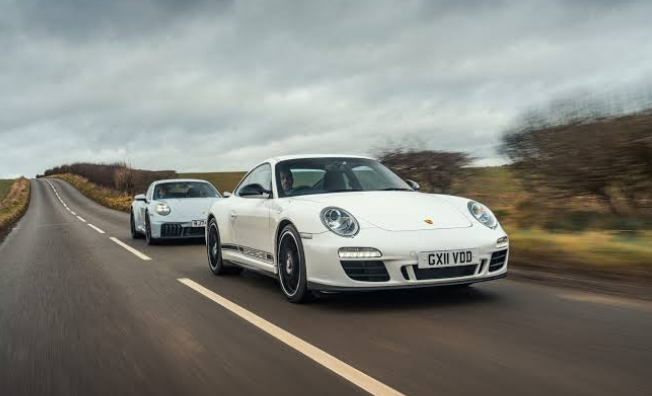
So, how does a 15-year-old, naturally aspirated predecessor answer to that level of digital dominance? To find out, I spent an afternoon with a pristine, collector-grade 997 GTS. Finding the right spec is crucial here. Unlike many models on the used market saddled with early PDK gearboxes, this particular car is a rear-wheel-drive, manual coupe—without question the holy grail configuration for a Porsche 911 Carrera GTS from this era. Showing just 45,000 miles and featuring zero optional extras that would dilute the driving purity, it represents the 997 at its absolute peak.
Approaching the car, it looks undeniably beautiful, though its proportions feel distinctly vintage, especially from the rear. This shouldn’t be surprising, considering the core architecture debuted with the 996 nearly three decades ago. Climbing inside, the cabin is a masterclass in functional minimalism. The Alcantara-wrapped steering wheel is completely devoid of buttons. (A quick word of advice for anyone looking at early automatic models: avoid the standard PDK rocker switches at all costs and hold out for a car optioned with proper paddles, or look into aftermarket Porsche performance tuning solutions to retrofit a modern wheel).
Ahead of you sits the iconic five-dial analog instrument cluster, and beneath the archaic, pixelated navigation screen are wonderfully tactile physical climate controls. You start the car by physically inserting a key into the left-side ignition slot and turning it. It’s a beautifully mechanical handshake that modern cars have entirely lost.
Within the first mile, the 997 GTS reminds you exactly what the sports car world has sacrificed in the pursuit of lap times. The six-speed manual gearbox offers an oily, precise, and deeply mechanical action. It is a tactile joy that modern 911 buyers—outside of GT3 allocations—simply cannot access anymore. Even the complex seven-speed manual offered on the previous 992.1 GTS doesn’t hold a candle to the organic feel of this older six-speed.
The 3.8-liter flat-six is more subdued than the angry bark of the new hybrid motor. It is buttery smooth and remarkably tractable at low RPMs. Being a second-generation 997 (the 997.2), this direct-injected engine is completely free of the infamous IMS bearing issues that haunted earlier water-cooled models, making it highly desirable on the collector market and surprisingly reasonable when quoting high-end auto insurance policies compared to newer supercars.
But make no mistake: the straight-line performance isn’t even in the same zip code as the 2025 model. For the lower half of the tachometer, the original Porsche 911 Carrera GTS feels no faster than a standard Carrera S from the same year, because the power curves are virtually identical up to 6,000 RPM. It’s only in the final shrieking climb to the 7,300 RPM redline that a special resonance flap opens in the intake manifold, allowing the GTS to breathe deeper and pull harder at the top end.
Performance Comparison: The Spitfire vs The F-35
Reviewing my old journalistic notes from 15 years ago, I found a phrase I penned after my first drive in the 997: “So far, so fairly good.” Judged against the titans of its day, it was excellent, but part of me had clearly expected a bit more raw aggression from a new badge.
But here is the secret to the original Porsche 911 Carrera GTS: the harder you push, the more it reveals. I discovered this on a detour through an empty canyon pass while hunting for a gas station. With the oil fully up to temperature and the flat-six howling off the rock walls, the car shed its grand-touring demeanor. It doesn’t dominate the road with terrifying pace like the new Porsche 911 Carrera GTS; instead, it dances.
The defining factor is weight. The 997 is a massive 385 pounds (175 kg) lighter than the new hybrid model. Frankly, it’s a miracle the gap isn’t larger. The 992 is a physically wider, longer car, brimming with luxury tech, massive hybrid batteries, electric motors, rear-wheel steering actuators, and crash safety structures.
Combine that 385-pound weight advantage with a wheelbase that is four inches shorter, and swap the modern synthetic electric steering for old-school hydraulic assist, and the result is magical. The 997 feels lithe, communicative, and perfectly scaled for tight backroads. If the new 992 hybrid is a modern F-35 fighter jet—relying on immense thrust and computer processing to manipulate physics—the 997 is a P-51 Mustang. Both are devastatingly effective, but one requires the driver to be a mechanic, while the other makes you a system operator.
On those same tight canyon roads, the new Porsche 911 Carrera GTS felt caged. Its performance is so explosive that straightaways vanish instantly, forcing you hard onto the brakes before the next apex. I could only safely tap into perhaps 30 percent of its capability on public roads. In the 997, I was ringing it out to the redline in three gears, deeply immersed in the act of driving without risking immediate impoundment.
The Wildcard: Driving the Porsche 911 S/T
To put all of this into perspective, I recently spent time in the ultra-exclusive Porsche 911 S/T. With its gorgeous retro-tweedy interior honoring the racing 911s of the early 1970s, it represents the absolute peak of Stuttgart’s modern internal-combustion engineering.
Yet, as the lightweight clutch engaged, the promised driving nirvana didn’t immediately materialize. The culprit? The weather. The roads were slightly damp from a morning drizzle. The S/T comes wrapped in aggressive Michelin Cup 2 premium performance tires. While these tires are black magic on a hot, dry race track, on damp public asphalt, they demand immense respect. The breakaway characteristics of a cold Cup 2 tire are abrupt. There are no graceful, progressive slides to catch with a dab of oppo; there is only grip, followed instantly by a frantic save.
It begs the question: why outfit a car explicitly designed and marketed for ultimate road-driving pleasure—a car Porsche famously refused to set a Nürburgring lap time for—with track-day rubber? It pushes the limits of the chassis so far into the stratosphere that they become inaccessible on dry public roads, while making the car nerve-wracking on wet ones. If I were lucky enough to secure an S/T, my first stop would be a tire shop to mount a high-performance summer street tire. Sacrificing a few fractions of a G in ultimate cornering force is a small price to pay for predictability and joy.
The Verdict: Evolution of the GTS
Over the last 15 years, the Porsche 911 Carrera GTS has evolved from a clever dealership inventory solution into the most technologically advanced, brutally fast daily driver in the sports car world. The new 992 T-Hybrid is a masterpiece of modern engineering, effortlessly blending earth-shattering speed with daily usability. It represents the future.
Yet, for pure driving romance, the analog feedback of the 997 GTS remains a high-water mark for the brand. It doesn’t just transport you down a road; it invites you to be part of the mechanical process.
Whether you are seeking the ultimate modern weapon or hunting for a modern classic that will appreciate in both value and sentiment, the GTS badge delivers. If you’re ready to experience this evolution for yourself, I highly recommend visiting your local dealership or connecting with a specialist broker today to get behind the wheel of a Porsche 911 Carrera GTS—because reading about the thrill of a flat-six is nothing compared to feeling it grip the pavement.